


This question is usually answered by agencies, and this answer is no exception: we’re one too, so read it with that in mind. We’ll say plainly where we fit and where we don’t, and we won’t name or rank anyone else.
The honest answer is that there is no single best agency for coaches and speakers. There is a best fit for your stage and for the job you need done. Get those two right and the list of candidates shrinks fast. Get them wrong and even a very good agency will disappoint you.
Why coaching and speaking businesses are different
A thought-leader business isn’t a normal small business with a website bolted on. A few things make it its own buying decision:
- You are the product. The brand has to sound like you, on camera, in email, on stage. A partner who flattens your voice into generic “marketing copy” costs you the one asset competitors can’t copy.
- Revenue often arrives in waves. Programs, cohorts, certifications and book releases open and close. The machinery has to handle a launch week and keep leads coming between launches.
- The stack is specific. Opt-ins, email sequences, webinars, sales pages, memberships, course platforms and payment plans, all talking to each other.
- Your claims get scrutiny. Results testimonials and income stories are the currency of this market, and they are also exactly what the FTC watches. More on that below.
Which kind of partner do you actually need?
Before you compare agencies, compare types. Each is the right answer for someone.
| Type of partner | Best for | Watch out for |
|---|---|---|
| Freelancer | One well-defined task: a landing page, an email sequence, a logo | You become the project manager connecting everyone |
| Channel specialist (ads, SEO, social) | Scaling one channel that already works | Can optimize a channel that isn’t your bottleneck |
| Launch specialist | A defined launch window with a fixed date | Quiet between launches; may not build what lasts |
| Generalist agency | Broad small-business marketing | May not know funnels, webinars or personal brands |
| In-house marketer | Steady, ongoing work with enough volume for one person | One person rarely covers strategy, design, dev, copy and ads |
| Full-service team | Strategy, site, funnels and launches that must move together | More than you need if the offer is unproven and budget is tight |
Stage matters as much as type, and so does budget. If you’re still filling your first roster and money is tight, you probably don’t need an agency yet. Start with the channels in how to get more coaching clients, and if you haven’t opened for business, how to launch a coaching practice. If you do have the budget, the calculation changes: a good partner can help you shape the offer and then test it in the market, instead of only amplifying something that already works.
What to look for
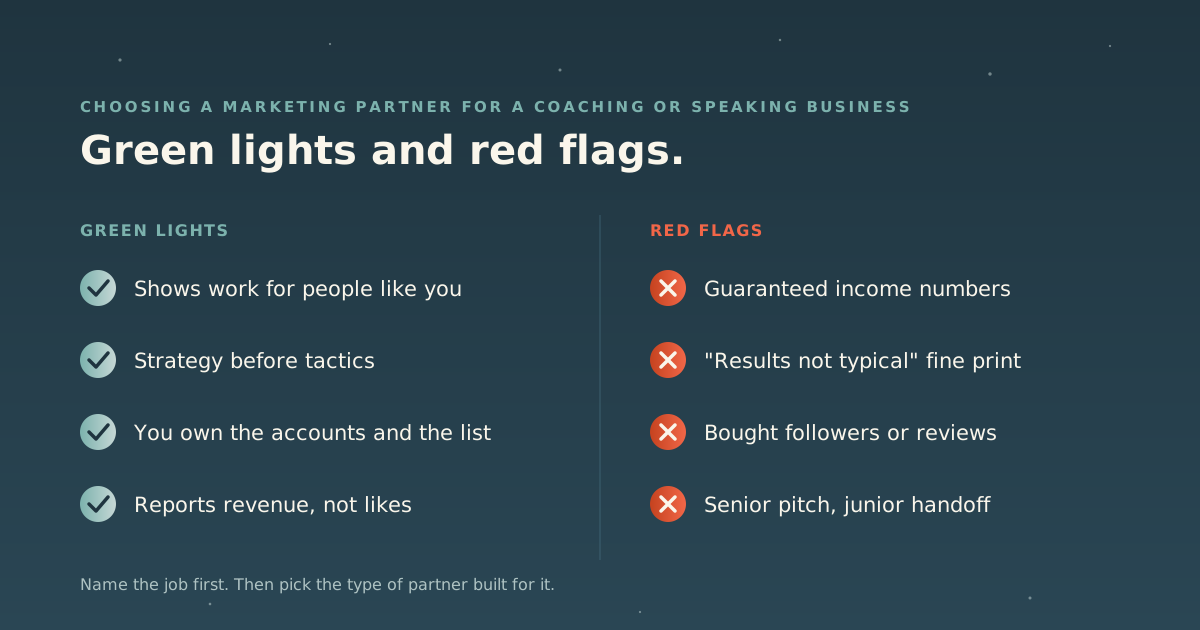
1. Work for people like you, that you can inspect. Logos are cheap. Ask to see the actual site, the sales page, the email sequence, the launch. Better still, ask what the brief was and what changed afterwards.
2. Strategy before tactics. A good partner asks who you serve, what you sell and at what price before recommending a single channel. If the first call is a pitch for a package, the package is the strategy.
3. Ownership. Your domain, hosting, email platform, list, ad accounts and analytics should be in your name, with the partner invited in. Leaving an agency should cost you a relationship, not your business.
4. Revenue-shaped reporting. Followers and impressions are fine as context. The report that matters shows leads, conversion, sales and where they came from, on a regular rhythm.
5. Respect for your voice. Ask how they capture it. Interviews, your past talks and books, a review loop you control.
6. Fluency in the compliance side. They should raise testimonials and earnings claims before you do.
What real thought-leader engagements look like
Our own case studies are the clearest way we can show what each kind of engagement involves, and what to ask any partner about.
A deadline sprint: Jeff Walker. Jeff’s site was on a dated theme that wasn’t built for mobile, with his book Launch due out. We used a mood-board process to settle the visual direction in days, ran brand, content and build in parallel, and rebranded, redesigned and relaunched JeffWalker.com in 10 days, along with a premium redesign of his “16 Rules of Internet Success” lead magnet. The lesson for buyers: when a date is fixed, ask a partner exactly how their process compresses, and what they’d cut.
A platform the client can drive: Brendon Burchard. Brendon’s brief was a site he and his team could run every day. We replaced a non-mobile-friendly HTML-tables build with a responsive custom WordPress build, and wired opt-in tools into it so his team could launch campaigns without custom development. The lesson: ask what your team will be able to do without the agency once it’s built.
A long-term, staged partnership: Sonia Choquette. The work unfolded in stages: first a stable platform, then her YouTube channel, then new digital products and her coach-training certification. The case study reports 315% subscriber growth and 5.5 million annual YouTube views (2025), and more than 25,000 registrants for the certification launch, the biggest in her history. The lesson: ask what the partner would do first, and what it would deliberately leave for later.
A full marketing department: James Van Praagh. After two years of sliding revenue, we served as his whole marketing team on a retainer, with a standing 30-minute weekly sprint review. In the first six months, average monthly sales rose 262% against the prior year, with store conversions up 161% and average order value up about 20%. The lesson: ask how often you’ll meet, who is in the room, and what gets reported.
Those are four different engagement shapes. None of them is “the” right one. The right one is the shape that matches your job.
Questions to ask before you sign
- Show me two or three projects for coaches, speakers or authors. What was the brief, and what changed afterwards?
- Who will actually do the work, and who is my day-to-day contact?
- What would you do in the first 90 days, and what would you leave alone?
- Which accounts will be in my name, and what do I keep if we part ways?
- What will you report, how often, and what counts as success?
- How do you capture my voice, and who approves copy?
- How do you handle testimonials, case studies and income claims?
- How is the engagement structured: a project, a retainer, or step by step? What’s the exit?
- What would make you tell me I don’t need you yet?
The last question is the most revealing. A partner who can’t imagine saying no isn’t really advising you.
For the general process behind these questions (engagement models, reading a case study like an auditor, checking references, and what to get in writing), see how to vet a marketing agency.
Red flags
- Guaranteed income or revenue numbers. No partner controls your offer or your market.
- “Results not typical” doing the heavy lifting. See the next section.
- Bought growth. Followers, views or reviews that arrive suspiciously fast.
- A senior pitch and a junior handoff. Meet the people who will do the work.
- Accounts in the agency’s name. Especially your email list and domain.
- Tactics before questions. A package offered before they understand your offer.
- Reports full of reach and empty of revenue.
The compliance part most buyers skip
Coaching is sold on results, which is why the FTC’s rules deserve a place in your agency decision.
- Results testimonials are read as typical. The FTC’s endorsement guidance says endorsements claiming specific results will usually be interpreted to mean others can expect the same, and that statements like “Results not typical” or “Individual results may vary” won’t change that interpretation. Advertisers can either prove the results are typical or clearly disclose the generally expected results.
- You stay responsible. The same guidance says your company is ultimately responsible for what others do on your behalf, and that delegating part of your promotional program to an outside company doesn’t relieve you of responsibility under the FTC Act.
- Earnings claims draw penalties. In October 2021 the FTC sent a Notice of Penalty Offenses to more than 1,100 businesses offering money-making opportunities, a list that included investment and business coaching, warning that misleading earnings claims could bring civil penalties (the press release put them at up to $43,792 per violation at the time). The FTC also said being on that list didn’t suggest a business had done anything wrong.
- Fake reviews and bought influence are banned. The FTC’s August 2024 final rule prohibits fake reviews and testimonials, reviews bought on the condition they’re positive (or negative), and buying fake social media indicators such as bot-generated followers or views when the buyer knew or should have known they were fake.
None of this is legal advice, and if you sell a business-building or income-related program, talk to a qualified advisor. The practical test for an agency: when you ask question 7, do they have an answer?
Where Peaceful Media fits, and where we don’t
We’ve been doing this for eighteen years, and we made our name with the first wave of online thought leaders. Our About page names Brendon Burchard, Joe Polish, Jeff Walker, Sonia Choquette, Mary Morrissey and Jeff Shore. Brendon’s case study notes that his site became our social proof and led directly to collaborations with Jeff Walker, Sonia Choquette and Joe Polish, among others. The way we work is one team carrying strategy, story, build and launches from the plan to the numbers, which is why the engagements above range from a 10-day sprint to a full marketing department.
We’re likely a fit if you have an established body of work and an audience, and you need strategy, a site, funnels and launches to move as one system rather than across a patchwork of freelancers.
We can also help earlier than that, if you have the budget. Before an offer is proven, we can help you develop it, give you honest feedback on it, and then test it in the market: lead generation, discovery calls, and ad campaigns that get you in front of the people you want to serve.
We’re likely not the right first step if budget is a real concern and you haven’t yet proven an offer. For that stage, the channels and machinery in how to get more coaching clients, a solid lead magnet, and a list you grow steadily will do more than any agency. When a newer practice does want help, one focused asset (like the exit readiness scorecard we built for Exit Strategy Coach) usually makes more sense than a whole department.
Either way, most engagements with us start with a low-cost strategy workshop. You can take the roadmap and run with it, or have us implement it, with no lock-in either way.
The honest bottom line
The best marketing agency for a coach or speaker is the one that fits your stage, has done your kind of work in a form you can inspect, builds things you own, reports in revenue, and protects your name on the compliance questions. Name the job first. Then choose the type of partner built for it. Then ask the nine questions and let the answers do the ranking.
Sources: FTC, “FTC’s Endorsement Guides: What People Are Asking”; FTC, “FTC Puts Businesses on Notice that False Money-Making Claims Could Lead to Big Penalties” (October 26, 2021); FTC, “Federal Trade Commission Announces Final Rule Banning Fake Reviews and Testimonials” (August 14, 2024). Client details are from our published case studies, and agency history is from our About page.