


Choosing a marketing agency usually goes like this: you take four calls, three of them are impressive, and you pick the one you liked most. That’s how you end up six months into a retainer wondering what you’re paying for.
A better way is to run a process. Decide what you need before anyone pitches you, then test every agency against the same brief, the same evidence standard and the same contract terms. We’re an agency, so read this with that in mind. We won’t name or rank anyone else, and everything below applies to us too.
Step 1: Write the brief before you take a call
If you don’t define the job, the first agency you talk to will define it for you, usually as whatever it sells. One page is enough:
- The job. “Rebuild the website before our spring launch” or “turn our ad spend into booked calls” is a job. “Help with marketing” is not.
- What success looks like, and by when. Leads, sales, booked calls, a launch date. Pick the number you’d actually use to decide whether to renew.
- Your starting point. Current traffic, leads, conversion, ad cost. If you don’t know these, measure them first. You can’t judge an agency’s results without a baseline, and a free check like our Website Analyzer is one quick way to record where your site stands today.
- The budget you can sustain. Not just the first month: the monthly amount you could keep paying if results take a while.
- Who owns it on your side. Someone has to answer questions, approve work and read the reports.
Send the same brief to every agency you shortlist. Now their answers are comparable.
Step 2: Pick the engagement model before you pick the agency
Agencies charge in a few basic ways. Each suits a different kind of job, and the wrong model can sink a good agency. We’re deliberately not quoting fee ranges: they vary widely by scope and market, and we haven’t found a source we trust to put numbers on them.
| Model | Good for | Watch for |
|---|---|---|
| Project (fixed scope, fixed fee) | Work with a finish line: a website, a brand, a launch, a funnel build | Scope creep and change orders. Get the deliverables and the number of revision rounds in writing |
| Retainer (monthly fee, ongoing) | Work that compounds: ads, content, email, SEO, running launches | Paying for “availability” with no defined output. Ask what a typical month produces |
| Performance-based (fee tied to results) | Channels where results are cleanly measurable | Who defines and measures the result, and whether the agency is chasing the cheapest conversion rather than the best customer |
| Hourly | Advice, audits, small fixes | Open-ended bills. Set a cap |
Many good engagements combine them: a paid strategy or discovery phase first, then a project, then a retainer if the work needs ongoing hands. A smaller first step also doubles as a trial. You learn how an agency communicates and hits deadlines before you commit to anything large.
On ad management specifically, ask how fees and ad spend are shown on invoices. Google’s transparency requirements for third parties say that if an agency charges a management fee separate from the cost of Google Ads, it must tell customers in writing before the first purchase and show the fee on every invoice, and that reported Google costs should be the exact amount Google charged, exclusive of the agency’s fees.
Step 3: Read case studies like an auditor
A case study is an ad. That doesn’t make it false, but it does mean you should read it for what it contains, not for how it makes you feel.
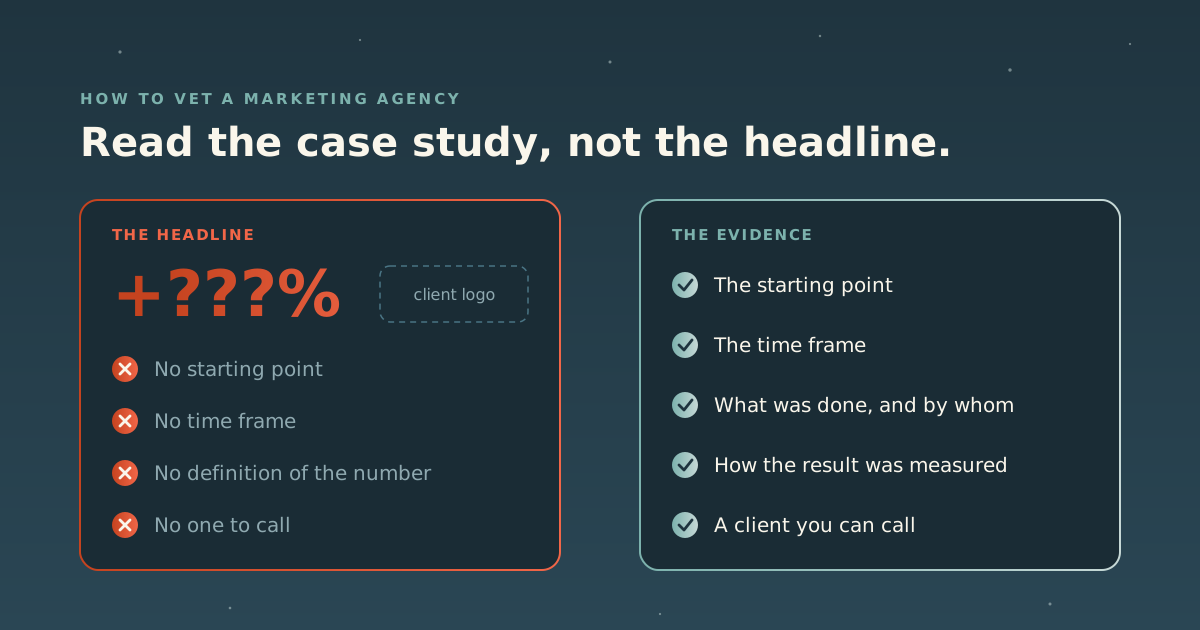
What a real case study contains:
- The starting point. What was broken or missing, with numbers where they exist.
- The time frame. A result over three weeks and a result over three years are different stories.
- What was done, and by whom. Specific work, not “we unlocked growth”. Was the agency the whole team, or one vendor among several?
- How the result was measured. Revenue or leads? Before or after ad spend and fees? From which date to which date?
- A client you can check. A named client, ideally one who will take your call.
For an example of the level of detail to expect, our own Soil Food Web School case study states the starting point (an email list under 3,000), the time frame (four years), the work (quiz funnels, paid media, CRM rebuild, quarterly launches) and how the launch returns were counted (after ad spend and our fees). Hold ours to the same test as anyone’s.
How to spot a cherry-picked metric:
- A percentage with no baseline. “Traffic up 400%” from 50 visits a month is 250 visits a month.
- No time frame, or a suspiciously short one. One great month tells you about that month.
- A vanity metric standing in for money. Impressions, followers and “reach” are context. Ask what happened to leads and sales.
- Return figures without a definition. Ask what was counted as cost. Ad spend only, or ad spend plus fees?
- One client’s best result presented as typical. The FTC’s endorsement guidance says endorsements claiming specific results will usually be read to mean others can expect the same, and that “Results not typical” or “Individual results may vary” won’t change that. So ask the agency directly: what does a typical client of yours see?
Step 4: Check references the right way
Google’s guidance on hiring an SEO puts it simply: check business references, and ask past clients whether the agency provided useful service, was easy to work with and produced positive results. That advice works for any kind of agency. A few ways to get more out of the calls:
- Ask for two or three references, including one current client and one who has left. How an engagement ended tells you a lot.
- Ask what went wrong, and how it was handled. Every real engagement has a bad week. A reference who can’t name one either wasn’t close to the work or is being polite.
- Ask who did the work. Was it the people from the sales call?
- Ask whether the reports were useful, and whether they’d hire the agency again for the same job.
Treat online reviews as one input, not a verdict. The FTC’s 2024 rule on consumer reviews and testimonials prohibits fake reviews, reviews bought on the condition they’re positive, certain undisclosed reviews by company insiders, and websites a business controls that pose as independent reviewers of its own category. It also bars misrepresenting the reviews on a site as all or most of those submitted when negative ones have been suppressed. When a “top agencies” list ranks the site owner first, check who runs the list.
Step 5: Get accountability in writing
This is where most regret starts: not with bad work, but with unclear terms that turn a disappointing engagement into a hard one to leave.
Who does the work? Get names and roles for the people on your account, and ask whether any of the work goes to subcontractors. If the senior person from the pitch won’t be on your account, you want to know that now.
What gets reported, and how often? Agree on the few numbers from your brief, the reporting rhythm, and whether you get direct access to the underlying dashboards rather than screenshots. For Google Ads, Google’s advertiser guide says that at a minimum you have the right to know the number of clicks, impressions and the total cost of your ads. Google’s SEO guidance also suggests asking whether the agency will share every change it makes to your site, with the reasoning behind it.
Who owns what? Your business should own:
- The domain. ICANN notes that if you aren’t the registrant of record, you may not be able to access the domain, and that becoming the registrant of record gives you full control of it. You can look up a domain’s registrar with ICANN’s lookup tool.
- The ad accounts. Google’s advertiser guide says an agency must set up a separate Ads account for you, and its transparency requirements say agencies must give customers their Google Ads customer IDs when asked.
- Analytics, the website, the email list and the CRM. Invite the agency in as a user; don’t let them hold the keys.
- The work itself. Creative files, copy, ad creative and code you paid for. Spell out who owns what once invoices are paid.
How does it end? Before you sign, agree on the notice period, what happens to work in progress, and how access, files and logins come back to you. Google’s advertiser guide recommends getting an official copy of your agreement in writing. A good agency will have written exit terms already. Leaving should end a relationship, not break your marketing.
Red flags
- Guaranteed rankings or ad positions. Google says no one can guarantee a #1 ranking, and that a specific ad position can’t be guaranteed because it’s set by an auction that changes with every search.
- Cold outreach promising fixes. Google’s advice: be wary of SEO firms and agencies that email you out of the blue.
- Secrecy about methods. Google warns against companies that are secretive or won’t clearly explain what they intend to do, and reminds site owners that they are ultimately responsible for the actions of companies they hire.
- Claims that buying ads will lift your organic rankings. Google says advertising has no effect on organic results.
- Fees that aren’t broken out. You should be able to see ad spend and agency fees separately.
- Accounts in the agency’s name. Especially your domain, ad accounts and email list.
- Offers of fast reviews or followers. The FTC’s rule prohibits buying fake reviews, and buying bot-generated followers or views, when the buyer knew or should have known they were fake.
- A proposal before any questions. Google’s SEO guidance says a good one should ask what makes your business unique, who your competitors are, and how your customers find you. That holds for any agency.
Put it together: a simple scorecard
Shortlist three agencies, send each the same brief, and score them on the same questions.
| Check | What a good answer looks like |
|---|---|
| Understood the brief | Asked questions before proposing anything |
| Engagement model | Matches the job, with a sensible first step |
| Case studies | Starting point, time frame, work, measurement, named client |
| References | Includes a past client; they named a problem and how it was fixed |
| Team | Names the people doing the work |
| Reporting | Your numbers, a set rhythm, direct access |
| Ownership | Everything in your name, agency invited in |
| Exit | Written notice period and handover |
The agency with the best pitch often isn’t the one with the best scorecard.
Where Peaceful Media fits
We’re one of the agencies you might be vetting, so here’s how we answer the same questions. We charge by the shape of the work: some engagements are fixed-scope projects, others are ongoing partnerships where we act as your marketing team, and we scope to your goals and budget instead of forcing a retainer. Most clients start with our low-cost strategy roadmap, a focused engagement you can take and run with yourself or have us implement, with no lock-in either way. Our portfolio is there to be read the way this piece suggests.
If budget is a real concern and your offer isn’t proven yet, we’re probably not the right first step. If you have the budget, we can help earlier than most people expect: developing the offer, giving honest feedback on it, and testing it in the market through lead generation, discovery calls and ad campaigns. If you’re still working out what the machinery should look like, how to create a sales funnel is a good primer, and if SEO is on your list, do you still need SEO with AI search? covers what it’s worth now.
The bottom line
Vetting an agency is less about finding the most impressive one and more about making every candidate answer the same questions in writing. Write the brief, pick the model, read the evidence, call the references, and get ownership, reporting and exit terms on paper. The right agency will be glad you asked.
Sources: Google Search Central, Do you need an SEO? (updated June 2026); Google Advertising Policies Help, Advertiser guide: Working with third parties; Google Advertising Policies Help, Transparency requirements; FTC, FTC’s Endorsement Guides: What People Are Asking; FTC, Federal Trade Commission Announces Final Rule Banning Fake Reviews and Testimonials (August 14, 2024); ICANN, FAQs: Domain Name Registrant Contact Information. All sources as of September 2026. Client details are from our published case studies. None of this is legal advice.