


“Sales funnel” has picked up a bad reputation, and some of it is earned. The phrase conjures fake countdown clocks, a seventeen-email barrage, and a checkout page that reveals the real price at the last second.
Underneath the baggage is a simple, useful idea: a funnel is the deliberate path from stranger to customer. Instead of hoping visitors find their own way to buying, you give them a sequence of steps, each with one job. Then you can see exactly which step is losing people and fix that one.
This is the plain-English version: the six stages, the page or email each one needs, and the single number worth watching at each step.
What a sales funnel actually is
Picture your best customer on the day before they’d heard of you. A funnel is everything between that day and the day they buy, written down and built on purpose. The shape narrows because at every step some people leave. That’s expected. The point is knowing where they leave and why.
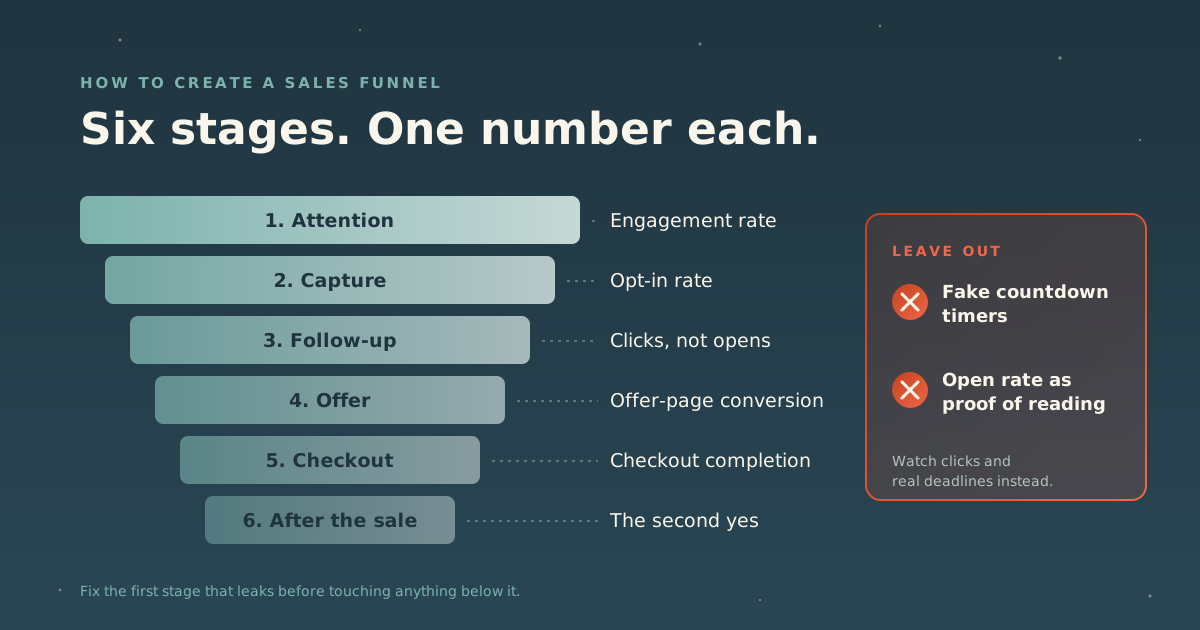
Here are the six stages we plan around, with the piece you build and the one number that tells you whether it’s working:
| Stage | What you build | The one metric |
|---|---|---|
| 1. Attention | One traffic source making one specific promise | Engagement rate on the landing page |
| 2. Capture | A single page that trades something useful for an email address | Opt-in rate (sign-ups ÷ visitors) |
| 3. Follow-up | A short automated email sequence | Clicks to the offer (not opens) |
| 4. Offer | A sales page or booking page | Conversion rate on that page |
| 5. Checkout | Payment, with as few steps as possible | Checkouts completed ÷ checkouts started |
| 6. After the sale | Delivery, a welcome, and the next step | The second yes: buyers who come back |
Most guides stop at stage five. The sixth is where repeat buyers and referrals come from, so we build it into the plan from day one.
Before you build anything: the offer and the one person
Funnels fail most often before the first page exists, because the offer is vague. “Coaching,” “a course,” or “my services” isn’t something a stranger can say yes to. “A six-week program that gets first-time managers through their first performance review” is.
Write down three things before you touch software:
- Who it’s for, specifically enough that the wrong people can tell it isn’t for them.
- What they get, in outcomes they’d use themselves, not features.
- What it costs, and whether the first step is a purchase, a call, or an application.
Everything downstream borrows from these three lines. If you can’t write them, the funnel will expose that, loudly and expensively.
Stage 1: Attention, and the promise that brings people in
Pick one traffic source to start: an ad campaign, a podcast guest spot, a search-ranked article, a partner’s newsletter. Each one makes a promise, and the page it points to has to keep it.
Google says as much about paid traffic. Its Google Ads help on landing page experience tells advertisers to make sure the page is “clear and useful to customers” and “related to your keyword and what customers are searching for.” That holds for every source, not just ads: an ad about pricing that lands on a homepage breaks the promise before the page has loaded.
The metric: engagement rate. In Google Analytics 4, a session counts as engaged if it lasts longer than 10 seconds, fires a key event, or includes two or more pageviews; bounce rate is simply the inverse. We unpacked that definition in how to decrease your website bounce rate. A low engagement rate at stage one usually means the promise and the page don’t match, or the page is too slow to survive the first few seconds (our speed guide covers the usual culprits).
Stage 2: Capture, one page with one job
The capture page (or landing page, or opt-in page) asks for one thing: an email address, in exchange for something the visitor actually wants.
The honest version of that trade is the one that works over time. Some of the most effective lead magnets we’ve built give people something real about their own situation rather than a generic PDF:
- Soil Food Web School ran three Typeform quizzes with scoring logic and dynamic reports, “so prospects got real feedback on their own soil, not a disguised opt-in form.” Per the case study, they became the business’s most profitable acquisition route.
- Exit Strategy Coach uses a three-minute scorecard that rates a business out of 60 across six value drivers and returns the three areas costing the most at sale. Seven days after it went live, the founder had signed two high-end coaching clients.
- Wonders of Wisdom runs a personality quiz that builds self-awareness, then an email series leading to a low-priced offer.
A quiz isn’t required. A short guide, a template, or a recorded workshop works too, as long as it’s useful on its own. What matters is that the page has one action on it and nothing competing with it.
On tooling: check what your email platform already does before buying anything. In our LeadPages review we explain why we reach for it less these days: platforms like Kit and ActiveCampaign now build good landing pages of their own. For scored quizzes, see our Typeform review.
The metric: opt-in rate, sign-ups divided by visitors to that page. We won’t quote you a “good” industry average here, because the published ones mix wildly different traffic and offers. Measure your own, then improve against it.
Stage 3: Follow-up that helps before it asks
A new subscriber hasn’t agreed to be sold to every day. They’ve agreed to hear from you about the thing they signed up for. A good follow-up sequence is a handful of emails that deliver on that, then end with a clear, single invitation to the offer.
Two ground rules:
- Keep it legal. In the U.S., the FTC’s CAN-SPAM compliance guide requires accurate “From” and subject lines, a valid physical postal address, a clear way to opt out, and that you honor opt-out requests within 10 business days.
- Match the promise again. If the lead magnet was about soil biology, the third email shouldn’t be a generic newsletter.
The metric: clicks to the offer, not opens. Apple’s Mail Privacy Protection, per Apple’s own documentation, “downloads remote content in the background by default, regardless of whether you engage with the email,” and is designed to prevent senders from learning about your Mail activity. An “open” recorded from those inboxes may not mean anyone read anything. A click is a person choosing to go further.
Stage 4: The offer page
This is the sales page, or the booking page if your first sale is a conversation. It should answer, in this order: what is it, who is it for, what changes for them, what does it cost, and what happens after they say yes. Proof belongs here too: testimonials, results, and the specifics of what’s included.
The non-sleazy test is simple. Could a skeptical friend read this page and know exactly what they’re buying and for how much? If the price is hidden until the last click, the answer is no.
The metric: conversion rate on this page, buyers (or booked calls) divided by visitors. If clicks from email are healthy and this number is poor, the problem is the offer or the page, not the traffic.
Stage 5: Checkout, where good funnels quietly leak
Checkout is the least glamorous page in the funnel and one of the most consequential. Baymard Institute, which studies ecommerce checkout usability, averages 50 published studies to a documented cart abandonment rate of 70.22% (list last updated September 22, 2025). That figure is for online retail generally, not funnels specifically, but the reasons it reports are instructive. Setting aside people who were just browsing, the reasons US shoppers in Baymard’s survey gave for abandoning included these four, all of them checkout design choices:
| Reason (Baymard Institute) | Share |
|---|---|
| Extra costs too high (shipping, tax, fees) | 40% |
| The site wanted me to create an account | 18% |
| Too long or complicated checkout process | 17% |
| Couldn’t see or calculate total order cost up front | 12% |
Nearly every item on that list is a design choice. Show the full price early, skip forced account creation, and cut every field you don’t need. For taking payment itself, Stripe is what we use wherever payments need to happen, and all-in-one platforms like Kajabi bundle checkout with delivery if you’d rather not assemble the pieces.
The metric: checkout completion, purchases divided by checkouts started.
Stage 6: After the sale
The funnel doesn’t end at the receipt. Delivery, a welcome email, and a clear next step turn one purchase into a relationship. For Sonia Choquette’s oracle bundle, we architected the post-purchase experience: confirmations, delivery emails, and follow-ups that invite buyers deeper into her membership.
The metric: the second yes. Whether buyers come back for a second purchase, an upgrade, or a referral. It’s the slowest number to move and the most honest verdict on whether the funnel sold something worth buying.
What about urgency?
Urgency is where most funnels tip into sleaze, so it deserves its own section.
A real deadline is fine. A live launch with a genuine cart-close date is just true. The problem is the fake kind. In its September 2022 report on dark patterns, the FTC named “countdown timers designed to make consumers believe they only have a limited time to purchase a product or service when the offer is not actually time-limited” as a deceptive practice.
Evergreen funnels (the kind that run continuously) sit in between. Tools like Deadline Funnel give each person their own window and actually enforce it. We’ve used it, and in our Deadline Funnel review we say two things plainly: it produces an incremental lift on a funnel that already works, and even honored properly, an evergreen deadline is still manufactured urgency. Our rule of thumb from that review: if you aren’t prepared to let a sale walk when the timer hits zero, don’t put the timer up. And ask first whether a good offer, explained well, would get there without one.
Measuring it without drowning in dashboards
You don’t need an analytics stack to start. You need each stage recorded as a distinct event, so you can see the drop-off between them.
In Google Analytics 4, that means marking the actions that matter as key events, which Google describes as measuring “actions that are important to your business.” Mark the opt-in, the checkout start, and the purchase as key events. Then read the six metrics from the table above once a week, and fix the first stage that’s leaking badly before touching anything below it.
Once real ad money is involved, attribution matters more. We reach for SegMetrics when a business is scaling and needs to know which campaign produced revenue, not just clicks. Smaller operations can keep it simpler: Michel Peruch’s diagnostic funnel stages every lead through a six-stage pipeline (New, Nurture, Follow-up, Booked, Won, Lost), which is itself a funnel report.
A build order that works
If you’re starting from nothing, build in this order:
- Write the offer: who, what, and price, in three lines.
- Build the offer page and checkout first. If nobody buys from a warm audience, the top of the funnel won’t save it.
- Build the capture page and lead magnet.
- Write the follow-up sequence, ending in one invitation.
- Test everything on a phone, from a cold browser, including a real purchase.
- Turn on one traffic source and measure for a few weeks before adding a second.
If you want a dated plan for a launch rather than a list, our free Launch Planner builds a roadmap with the assets, timing, and tools for each phase. For coaches specifically, how to get more coaching clients covers the channel side, and how to launch a coaching practice covers the offer.
The honest bottom line
A funnel isn’t a trick. It’s a path, built on purpose, with one job per step and one number per stage. The version that lasts is the honest one: a promise the page keeps, a lead magnet worth having, emails that help before they ask, a price you can see, and a deadline you mean.
That’s how we build them for clients, from lead engines like Soil Food Web School’s to challenge-driven funnels like UC Davis’s. If you’d like the whole path designed, built, and tested for you, that’s our sales funnel work.
Sources (read September 2026): Google Ads Help: About landing page experience · Google Analytics Help: Key events · Google Analytics Help: Engagement rate and bounce rate · FTC: CAN-SPAM Act: A Compliance Guide for Business · Apple: Mail Privacy Protection & Privacy · Baymard Institute: Cart abandonment rate statistics (updated September 22, 2025) · FTC: Report shows rise in sophisticated dark patterns (September 15, 2022)