


Most advice about starting a coaching practice is really advice about becoming a coach: the training, the presence, the questions. That part is well covered. The part that decides whether you still have a practice in two years is the business you build around the coaching, and almost nobody walks you through it in order.
So here it is in order, with real numbers where real numbers exist.
First, the business you’re actually entering
The profession is large and growing. The 2025 ICF Global Coaching Study (conducted by PricewaterhouseCoopers, with 10,035 valid responses collected in early 2025) puts the profession at a record 122,974 coach practitioners worldwide generating $5.34 billion in annual revenue, a 17% increase over its 2023 study.
The individual picture is more sobering, and more useful:
| ICF 2025 averages, per active coach practitioner | |
|---|---|
| Annual revenue from coaching | $49,283 |
| Fee for a one-hour session | $234 |
| Active clients | 12.4 |
| Hours per week working as a coach | 11.6 |
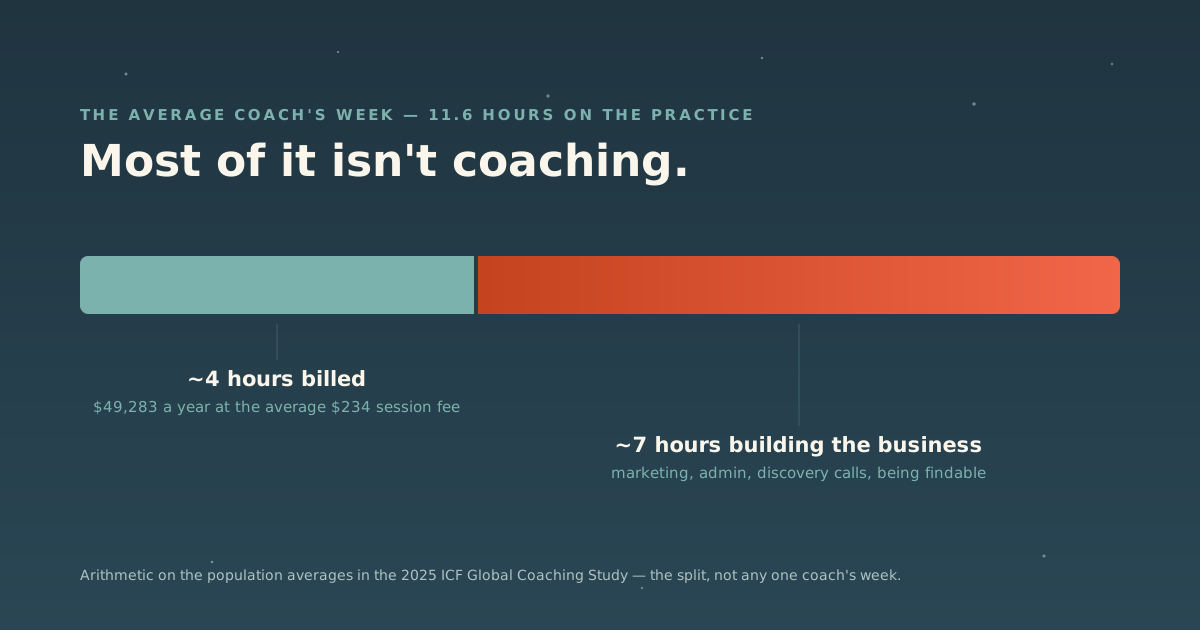
Put the first two together. At $234 an hour, $49,283 buys roughly 210 billed hours a year, about four a week against the 11.6 the average practitioner reports working. That’s rough arithmetic on population averages rather than a figure any one coach reports, but the shape holds: most of the week is not coaching. It’s marketing, admin, discovery calls that don’t convert, and the slow work of becoming findable.
That ratio is the single most important thing to plan around. A new coach who budgets time only for sessions has budgeted for about a third of the job.
The other pattern worth knowing: earnings track experience, hard. Coaches with more than ten years in the field average $69,721 a year, and Baby Boomer coaches average $60,323 against $33,553 for Millennials, charging $270 an hour versus $193. Client mix moves the same way: among coaches with under a year of experience, 18% primarily serve executives; past ten years, that’s 38%. You are entering at the bottom of a curve that rewards staying on it.
Step 1: Decide who you coach, before anything else
Nearly every downstream decision (your price, your website copy, which rooms you show up in) resolves instantly once you can finish this sentence: I help [specific person] get from [specific bad place] to [specific better place].
The market rewards it. ICF found 54% of coaches specialize in leadership and executive coaching, which tells you two things: that’s where the money concentrates, and that’s the most crowded room you could walk into with no differentiation. “Executive coach” is a category. “I help newly promoted engineering managers stop doing their old job” is a practice.
A workable niche is usually the intersection of a population you understand from the inside, a problem they already know they have, and a budget attached to solving it. If any of the three is missing, you’ll spend your first year educating a market instead of serving one.
This is the same discipline as brand positioning, and it deserves equal seriousness: a coach’s brand is their positioning.
Step 2: The credential question, answered honestly
Legally, you don’t need one. Coaching is not a licensed profession in the United States. As ProPublica reported in 2024, anyone can call themselves a life coach; ICF itself describes coaching as a self-regulated industry where credentialed members voluntarily agree to an ethics code. Regulators only get involved when a coach crosses into clinical territory: diagnosing a client or managing a mental health condition is the practice of therapy, and that requires licensure. Know exactly where that line is and refer across it without hesitation.
Commercially, it increasingly matters. ICF reports that 73% of coaches say clients and organizations expect a certification or credential. Since more than half of coaching clients are sponsored by their employer, the expectation is loudest where the larger contracts live.
If you pursue the ICF path, the requirements are public and specific:
| Credential | Coach-specific education | Coaching experience |
|---|---|---|
| ACC (Associate) | 60+ hours | 100+ hours |
| PCC (Professional) | 125+ hours | 500+ hours |
| MCC (Master) | 200+ hours | 2,500+ hours, PCC held first |
All three also require mentor coaching, a performance evaluation, and an exam. Training hours only count toward credentialing if they come from an ICF-accredited program. Level 1 programs run 60–124 hours and lead to the ACC; Level 2 programs run 125–175 hours and lead to the PCC. Check the accreditation level before you pay for a program, not after.
Note the shape of the ACC requirement: 100 hours of coaching experience. You cannot credential your way to a practice without clients, which means the marketing work in step 5 starts before the credential finishes, not after.
Step 3: The boring shell (do it once, badly is fine)
You can operate as a sole proprietor from day one, and many coaches do. The tradeoff, per the SBA, is that a sole proprietorship gives you no separation between you and the business: “you can be held personally liable for the debts and obligations of the business.” With an LLC, “your personal assets (like your vehicle, house, and savings accounts) won’t be at risk” in most instances. Both are taxed on your personal return by default.
The rest of the shell is short: a business bank account, a way to take payment (Stripe is the default for good reason), a simple coaching agreement that states plainly what coaching is and isn’t, and a conversation with an accountant about self-employment tax before your first quarterly payment is due, not after. Talk to a lawyer and an accountant in your state. This is a map, not advice.
Step 4: Design one offer, not a menu
New coaches routinely launch with three tiers, a Voxer add-on, and an à-la-carte hourly rate. It reads as flexibility and lands as uncertainty.
Launch with one offer: a defined engagement (say, twelve sessions over six months toward a stated outcome) at one price. It’s easier to explain, easier to sell, easier to deliver consistently, and it gives you a clean thing to improve.
On price: the $234 global average is a reference point, not a target. What moves it is the specificity of the outcome and the budget of the buyer. ICF also found that coaches expect their revenue to grow next year mainly through more clients (60%) and more sessions (51%), not higher fees (37%). The profession’s own consensus is that growth comes from volume and retention rather than from raising rates.
If your offer has a cohort, a cart, or a start date, the sequencing is a discipline of its own: that’s product launch work, and our free Launch Planner will build you a dated version of the runway to see what you’re signing up for.
Step 5: The smallest website that actually works
You don’t need a website to coach your first client. You need one to be chosen: by a stranger, by a referral checking you out before replying, and increasingly by an AI assistant answering “who’s a good coach for X.”
Five things, and nothing else at first:
- Who you help and what changes. Above the fold, in their words, not yours.
- Proof. Results, testimonials, credentials, the room you’ve been in. New coaches undersell this; a specific story beats a vague claim every time.
- You, as a person. Coaching is bought on trust, which makes the about page load-bearing rather than decorative. We wrote up what most about pages are missing.
- One obvious next step. A booking link to a discovery call. One. Every extra option is a place to hesitate. That’s the mechanic behind most bounce-rate problems.
- Speed. A site that takes six seconds on a phone loses people before they read the headline, and it’s rarely the images.
Build it on whatever you’ll actually maintain. The toolkit has our honest take on the platforms, including Kajabi if courses and memberships are in your future and Kit for the email list you should start collecting from week one. When you want a site that carries the brand properly, that’s what we do. See what it looked like for a NY Times bestselling author’s platform.
One addition that didn’t matter five years ago: make sure a machine can read you. Referrals now get verified by asking an assistant, and being quotable to AI search is mostly a matter of answering real questions in plain language on pages that load. Our free Website Analyzer grades that in about thirty seconds.
Step 6: Where the first clients actually come from
Almost always: people who already know you, and people they know. That is not a tactic you can skip past to get to the clever one.
Pick one outbound motion and one visibility motion, and do both badly for six months rather than doing five things once:
- The direct list. Everyone who knows your work: former colleagues, clients from your prior career, your training cohort. Not a broadcast; individual notes saying what you’re now doing and who you want to help.
- A room where your niche already gathers. A professional association, a Slack community, a conference, a podcast that serves them. Guest, don’t advertise.
- One signature asset. A talk, a workshop, or a webinar that delivers real value and ends with an offer. This is the highest-leverage single thing most new coaches can build, and it feeds everything else.
- A path from attention to conversation. A simple opt-in, a short email sequence, a booking link. That’s a sales funnel in its unglamorous version, which is the version that works. Once there’s enough volume to justify it, AI-assisted lead generation can take the qualifying off your plate.
What to skip in year one: a podcast with no audience, paid ads before you know what converts, a second niche, and a course. Every one of them is a way to feel busy while the roster stays empty.
Once you’re open and the question becomes how do I keep the roster full, we go deeper on the whole demand side (the five channels, how to pick two, and the follow-up machinery most practices never build) in how to get more coaching clients.
A realistic first 90 days
| Weeks | Focus |
|---|---|
| 1–3 | Niche and offer. Write the one-sentence positioning. Talk to ten people in it. |
| 4–6 | Business shell, pricing, coaching agreement, payment setup. Start training hours if you’re credentialing. |
| 6–10 | The five-part site. Email list live. Booking link works end to end. Test it yourself on a phone. |
| 8–12 | Outreach to people who already know you. Book discovery calls. Take your first paid clients, even at a starting rate. |
| Ongoing | Deliver, collect testimonials, log your coaching hours, repeat what converted. |
Ninety days gets you bookable. It does not get you full. Plan the runway for the version where it takes a year, and treat every month it beats that as a gift.
The honest bottom line
The permission part is free: no license, no gatekeeper, no minimum credential. That also means no scarcity, and no structural reason for anyone to pick you. Which is why the practice you build around the coaching is the whole game: a specific person you serve, one offer you can explain in a sentence, a site that can be found and can take a booking, and a repeatable way to get in front of people who already have the problem you solve.
None of that is glamorous, and all of it compounds. The ICF data says the coaches earning real money are the ones who stayed long enough for it to.
If you’d rather not assemble it piecemeal, strategy first is how we start with everyone.