


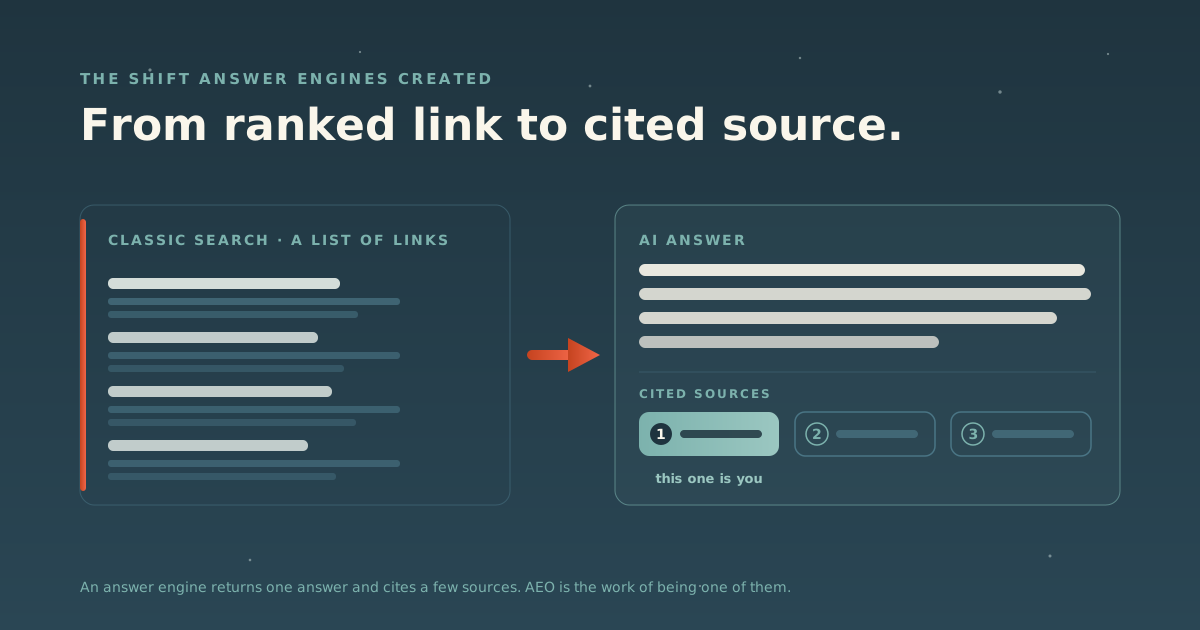
The question we get most often now isn’t “how do I rank on Google.” It’s some version of “how do I show up when someone asks ChatGPT.” It’s a fair question, and most answers floating around are either hand-wavy (“just be authoritative!”) or actively wrong (buy this tool, add this magic file). So here is the honest version, with every factual claim traced to a source you can check.
The short version is at the top of this page. The rest is why.
First, what “showing up in AI search” even means
“AI search” is a few different things wearing one name. Google now shows an AI Overview (a generated summary with a handful of links) above the classic results for many queries. ChatGPT search, Perplexity, and Google’s AI Mode answer in prose and cite their sources inline. The umbrella term for getting your content into those answers is answer engine optimization, or AEO, the side of search we work on.
The mental shift underneath the jargon is the whole point. Classic SEO competes to be a link the reader clicks. AEO competes to be the source the answer quotes. Those are related but not identical jobs, and the gap between them is why the question feels new.
It matters because the click is quietly disappearing. In a Pew Research Center study of 900 US adults’ actual browsing in March 2025, when an AI summary appeared, people clicked a traditional search result on just 8% of those pages, versus 15% when no summary appeared. Only 1% clicked a link inside the summary itself. When the answer is on the page, most people stop there. If you’re not in that answer, for a growing share of searches you’re not in the conversation at all.
How the answer engines actually pick sources
Nobody outside these companies has the ranking formula, and anyone who tells you they do is guessing. But the vendors have documented the mechanics, and that’s enough to work with.
Google’s AI Overviews and AI Mode run on the same Search index as everything else. Google describes a “query fan-out” technique: the system issues several related searches across subtopics, then synthesizes an answer from what it finds, a method generally called retrieval-augmented generation (grounding). Per Google’s own documentation, to be eligible as a cited link “a page must be indexed and eligible to be shown in Google Search with a snippet.” In other words: the front door to Google’s AI is ordinary Google indexing. There is no separate AI index to submit to.
ChatGPT search works differently under the hood but rhymes. Per OpenAI’s help docs, ChatGPT search “leverages third-party search providers, as well as content provided directly by our partners.” It sends an initial query, reads the results, then fires more specific follow-up queries: the same fan-out idea. To be surfaced, your site has to be reachable by OpenAI’s search crawler (more on crawlers next).
The common thread: these systems retrieve, then summarize. They are not reciting a memorized internet. They fetch pages at answer time, and they favor pages that give them a clean, quotable answer to lift. That single fact drives almost everything below.
The unglamorous first step: let the crawlers in
You cannot be cited by a machine that can’t read your page. This sounds obvious and is
the most common failure we see: a robots.txt rule, a login wall, or a JavaScript-only
page that renders nothing to a crawler.
The AI crawlers are separate from the classic ones and separate from each other, which trips people up. As of mid-2026 the names worth knowing:
| Crawler | Run by | What it’s for |
|---|---|---|
OAI-SearchBot | OpenAI | Surfacing your pages in ChatGPT search |
GPTBot | OpenAI | Collecting data to train OpenAI’s models |
ChatGPT-User | OpenAI | Fetching a page when a user’s prompt triggers a browse |
Google-Extended | Whether your content trains Gemini (not AI Overviews) | |
ClaudeBot / Claude-SearchBot | Anthropic | Model training / in-product search |
PerplexityBot | Perplexity | Perplexity’s search index |
Two traps live in that table. First, the training crawlers and the search crawlers are
different: block GPTBot (opt out of training) and you can still allow OAI-SearchBot
(stay in ChatGPT search), a reasonable stance for many businesses. Second, and widely
misunderstood: Google-Extended does not control AI Overviews. Per Google’s crawler
documentation,
that token only governs whether your content trains Gemini and “does not impact a site’s
inclusion in Google Search”; AI Overviews are part of Search, drawn from the regular
index. Blocking it removes nothing from the AI answer. Before you touch robots.txt, read
each vendor’s crawler docs, because the names and rules keep changing. OpenAI publishes theirs,
as do Anthropic
(ClaudeBot for training, Claude-SearchBot for search) and Perplexity.
While you’re checking access, check speed and rendering too. A page that takes twelve seconds to become readable, or needs JavaScript to show its text, is a page these systems struggle with. The same performance work that helps human visitors helps machines reach you.
Write answers, not just pages
Once a crawler can read you, the job is to be quotable. That means leading with the answer.
If a page’s real subject is “how much does branding cost,” the first thing on it should
be a direct, plainly written answer to that question, not three paragraphs of throat-
clearing about your studio’s philosophy. Retrieval systems reward pages where the answer
is easy to find and lift out cleanly. Question-shaped headings (## How do I show up in ChatGPT?) help both the machine and the human skimming on a phone, because
they mirror how people ask.
Two honest caveats, because the AEO industry oversells this one:
- You don’t need to chop your content into confetti. Google says outright there’s “no requirement to break your content into tiny pieces for AI to better understand it.” Write in clear sections with real headings; that’s the whole technique.
- You don’t need to write in robot-voice. Google, again: “You don’t need to write in a specific way just for generative AI search.” Clarity is not a special AI dialect. It’s good writing, which good SEO has always rewarded.
Back every claim with something quotable
Here’s where there’s real evidence, not just vibes. The first peer-reviewed study on this, “GEO: Generative Engine Optimization,” presented by a Princeton-led team at the KDD 2024 conference, tested thousands of queries and found that optimizing content the right way could raise a source’s visibility in generative answers by up to 40%.
What moved the needle is the useful part. The strongest methods were adding relevant quotations, statistics, and citations to authoritative sources, each producing a 30–40% relative improvement on the study’s main visibility metric. Improving the text’s readability helped too, if less (15–30%). And two popular tactics did not work:
- Keyword stuffing produced, in the authors’ words, “little to no improvement.” Techniques that once gamed search engines don’t transfer.
- Simply adopting an authoritative tone showed no significant gain. Sounding confident isn’t the same as being citable.
The authors are careful: effectiveness “varies across domains,” so treat 40% as a ceiling from a controlled study, not a promise. But the direction is clear and matches intuition: a machine assembling an answer reaches for the sentence with a real number, a real quote, or a real source attached, because that’s the sentence it can stand behind. Vague, unsupported prose gives it nothing to grab.
This is also, not coincidentally, the same instinct behind this article: the claims carry links you can verify.
Be a source worth quoting
The tactics above are amplifiers. What they amplify has to exist first.
Google’s guidance for its AI features, stripped of hedging, is to create content with “a unique point of view” that doesn’t “just recycle what others on the internet have already said, or could easily be produced by a generative AI model.” Read that twice, because it’s the strategic core: an answer engine has no reason to cite a page that merely restates what it could already generate. The pages pulled into answers are the ones offering something the model can’t synthesize on its own: first-hand experience, original data, a genuine point of view, specific expertise.
That’s not a trick, and it’s the part no tool sells you. When we graded our own site a C− and rebuilt it, the machine-readability work was mechanical; the durable advantage came from having actually done the thing we were writing about. First-hand knowledge is the one input a competitor can’t copy and a model can’t fake.
What you do not need to do
Because a lot of money is being made selling the opposite, here is the myth pile, answered from Google’s own guidance for AI features:
- You don’t need an
llms.txtfile. It’s a proposed convention, not an adopted standard. Google has said the file “isn’t treated in a special way.” It costs little to add and buys little today; don’t mistake it for the work. - You don’t need AI-specific schema markup. Google: “Structured data isn’t required for generative AI search.” Schema remains useful for classic SEO and rich results (keep it), but it is not the secret handshake for getting cited.
- You don’t need to buy your way in. There is no submission fee, no priority index, no ad slot inside an organic AI answer. The eligibility bar is being indexed and being good.
If a vendor’s pitch depends on one of those three, you now know more than the pitch does.
How to tell if it’s working
You can measure this without spending anything.
- Ask the assistants directly. Type your target questions into ChatGPT, Google’s AI Mode, and Perplexity, and read the answer. Who gets cited? Is it you, a competitor, or a page you could plausibly beat? This is the same move we added to the keyword-research workflow, and it’s the fastest reality check there is.
- Watch Search Console. Google added a generative-AI performance view to Search Console, so you can see AI-surface impressions on your own data rather than guessing.
- Check that you’re readable in the first place. Our free Website Analyzer grades how legible your pages are to search engines and AI assistants; Google’s own PageSpeed Insights covers the speed-and-rendering side. Use whichever; the point is to see your site the way a machine does before you decide what to fix.
Once you know what’s being cited and whether you’re even legible, the on-page work is the same craft we’ve documented for blog posts: one clear subject per page, the answer up top, claims backed with specifics.
The honest bottom line
Answer engine optimization is young enough that certainty should make you suspicious. The formulas are proprietary, they change often, and the same query can produce different citations week to week. Anyone quoting you a guaranteed method is selling the guarantee, not the method.
But the fundamentals are unusually stable, precisely because they aren’t tricks: be reachable, answer the real question directly, prove your claims, and know something worth knowing. That’s what earned rankings a decade ago and what earns citations now, which is the quiet reassurance underneath all the acronym anxiety. AEO didn’t replace the job. It gave the same job a new and less forgiving reader, one that reads your page and decides, in a sentence, whether you were worth mentioning.
If you want a partner for that work rather than a checklist, it’s what we do, and we pointed all of it at ourselves first.