


There is a particular kind of stuck that working coaches land in. The coaching itself is good. Clients get results. Yet the roster has holes in it, the month starts with a knot in your stomach, and the advice on offer is a firehose of tactics: post daily, start a podcast, run ads, build a course, get on LinkedIn, do a challenge.
Almost none of that is the actual problem, which is that nothing in your practice repeats. Clients arrive, but you couldn’t say where the next three are coming from. Here is the version that works: arithmetic first, then two channels, then the machinery that catches what the channels produce.
(If you aren’t open for business yet, start with how to launch a coaching practice: the positioning, the offer, and the minimum viable site. This piece picks up where that one ends.)
Start with the number, not the tactic
Before you choose a single channel, work out how many new clients you need per month. The formula is embarrassingly simple:
Target active clients ÷ average engagement length in months = new clients needed per month
A coach who wants 20 active clients on six-month engagements needs about three new clients a month, forever, just to hold steady. A coach running twelve-month engagements toward the same roster needs fewer than two.
That number changes everything downstream. Three clients a month is a relationships-and-conversations problem. You do not need an audience. You need a handful of the right conversations. Thirty clients a month is a different business that needs volume, systems, and probably paid traffic.
For a reality check on scale, the 2025 ICF Global Coaching Study (conducted by PricewaterhouseCoopers with 10,035 valid responses collected between February and April 2025) found the average active coach practitioner works with 12.4 active clients, charges $234 for a one-hour session, and earns $49,283 a year from coaching. A full practice is a small number of people. Most coaches are trying to solve a twelve-person problem with audience-building tactics designed for twelve thousand.
One more number worth sitting with: 59% of coaches expect their revenue to rise next year, and expect it to come from more clients (60%) and more sessions (51%), not higher fees (37%). The entire profession is planning to compete for the same clients. Being deliberate about how you find yours is no longer optional.
The five channels that actually fill a coaching practice
There are only about five, and they behave very differently. The honest version:
| Channel | Time to first client | What it costs you | Ceiling |
|---|---|---|---|
| People who already know you | Days to weeks | Discomfort, not time | Low (it runs out) |
| Referral partners | Weeks to months | Relationship maintenance | Medium, and steady |
| A signature talk or webinar | Weeks | Real prep, then it repeats | Medium to high |
| Other people’s audiences | Months | Pitching, travel, prep | Medium, compounds |
| Search and answer engines | 6–18 months | Sustained writing | High, compounds hardest |
People who already know you is the fastest and most skipped, because it feels like asking a favor. It isn’t a broadcast. It’s individual notes to former clients, people you coached free, former colleagues, and your training cohort, naming the specific person you’re looking to help and asking whether one name comes to mind. Vague asks get vague answers.
Referral partners are people who serve the same client just before or just after you do: therapists, financial planners, HR leaders, recruiters, lawyers handling divorces or exits, other coaches with a different niche. This is the most underrated channel in coaching, because one good partner sends a trickle for years and the relationship costs one coffee a quarter to maintain. Aim for three, not thirty.
A signature talk or webinar is the highest-leverage single asset most coaches can build. One useful hour (delivered to an association, a company lunch-and-learn, a partner’s audience, or your own list) does the demonstrating that a sales page cannot. You are not describing your coaching; they are experiencing a small piece of it. Build it once and it becomes your answer to every “can you come speak to our group” for years. (Ours live on the webinars page if you want to see the shape of one.)
Other people’s audiences (podcast guesting, guest teaching, association newsletters, joint workshops) is the same logic pointed outward. Borrow trust that already exists rather than building it from zero. Guest, don’t advertise.
Search and answer engines is the slowest and the only one that compounds without you. It’s also the one that changed most recently, which deserves its own section.
Pick two. Run both for two quarters.
The most common failure mode is doing five things once. Every channel above has a warm-up period, and abandoning one at week six guarantees you pay the cost and never collect.
Pick one relationship channel and one visibility channel, and commit to both for two full quarters:
| If your situation is… | Relationship channel | Visibility channel |
|---|---|---|
| Empty roster, need clients this quarter | People who already know you | A signature talk or webinar |
| Steady but plateaued | Referral partners | Other people’s audiences |
| Niche is well-defined, playing a long game | Referral partners | Search and answer engines |
| Corporate or executive coaching | Referral partners inside HR/L&D | A signature talk, delivered internally |
Choosing well is mostly about knowing your buyer precisely enough to know where they already gather. That’s the same work as knowing your audience deeply, and it’s what strategy is for.
The part almost every coach skips: the machinery
Here is the gap in the data, and it is the most useful finding in the whole ICF study for anyone trying to grow.
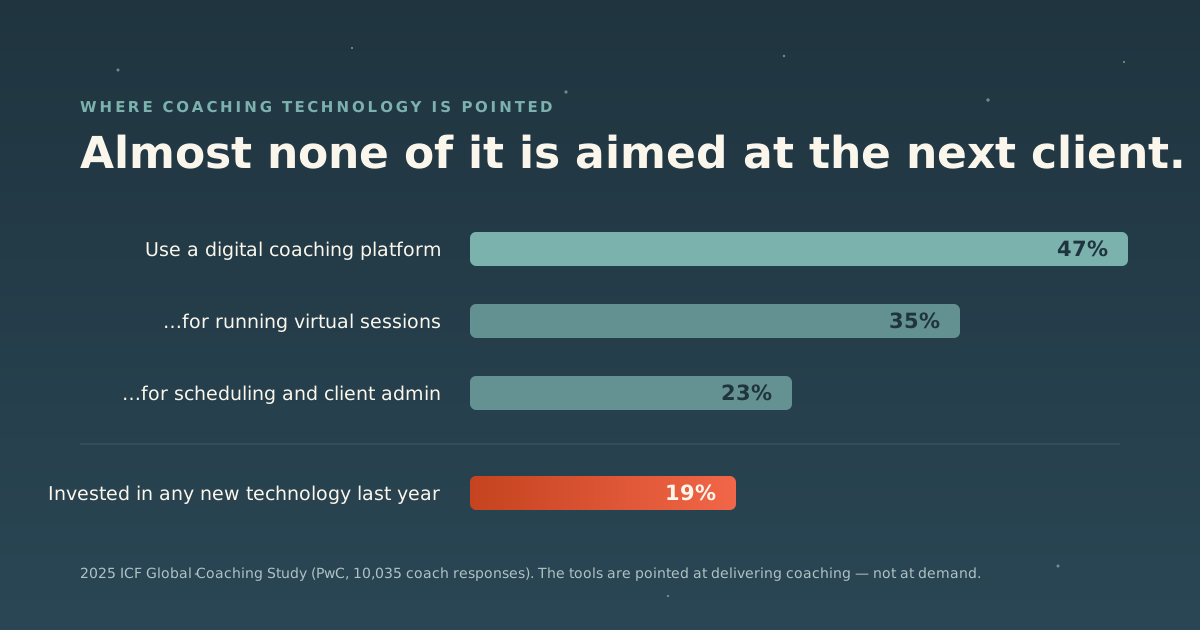
47% of coaches now use digital coaching platforms. But look at what they use them for: one-on-one virtual coaching sessions (35%) and scheduling and client management (23%). Meanwhile only 19% of coaches invested in any new technology in the past year (set to rise to 27% over the next one to three years), and 37% say adapting to technology and digital tools is a major concern, even as 54% say better platforms are a priority for meeting future client demands.
The profession’s tooling is pointed almost entirely at delivering coaching and administering it. Hardly any of it is pointed at finding the next client. That’s the gap, and closing it is unglamorous:
- A reason to give you an email address. Not “join my newsletter.” A specific, immediately useful thing for the specific person you serve: an assessment, a short guide, a template, a recorded workshop.
- A short nurture sequence. Four to six emails that deliver real value and end with a clear invitation. Written once, sent forever.
- A booking link that works. Test it yourself on a phone, from a cold browser. This breaks more often than anyone believes.
- One place every lead is recorded. A spreadsheet counts. What doesn’t count is your inbox.
The tools are cheap and boring. Kit is the easiest starting point for a solo coach; ActiveCampaign when the automation gets real; Keap or HubSpot once you’re tracking a pipeline rather than a list. Typeform for the qualifying questions before a call, Leadpages for a landing page if your site can’t produce one, AddEvent for the scheduling side. Our honest take on all of them lives in the toolkit, including which ones to skip.
Assembled, that’s a sales funnel: the unglamorous version, which is the version that works. Once enough volume justifies it, AI-assisted lead generation can do the qualifying so you spend your calendar on the people most likely to say yes.
Why search alone won’t carry you anymore
If your plan is “write blog posts and wait,” you need to know what happened to search.
The Pew Research Center tracked the actual browsing behavior of 900 U.S. adults across 68,879 Google searches in March 2025. When a search produced an AI summary, users clicked a traditional search result on just 8% of visits, against 15% when there was no summary. Only 1% clicked a link inside the summary itself. And 26% of visits to a page with an AI summary ended the browsing session entirely, versus 16% without.
That is not the death of search. It is search paying out differently: fewer clicks, and more value in being the source the answer is built from. For a coach, that means a referral now gets verified by asking an assistant, and “who’s a good executive coach for newly promoted engineering managers” is a question a machine answers by reading pages like yours.
The writing still matters, but it has to be answer-shaped. Real questions, plain language, on pages that load. We wrote the full method up in how to show up in ChatGPT and AI search, and the keyword side in how to do keyword research. If you’re weighing whether search is still worth funding at all, we worked through what the click data actually shows. It’s the same discipline pointed at two audiences, which is what SEO and AEO work has become.
Make sure the site doesn’t undo the work
Every channel above eventually sends someone to your website to decide. Three things break that moment most often:
- Speed. A site that takes six seconds on a phone loses people before the headline, and it’s rarely the images.
- Too many next steps. One obvious action beats four good ones. That’s the mechanic behind most bounce-rate problems.
- A weak about page. Coaching is bought on trust, which makes that page load-bearing rather than decorative. Here’s what most about pages are missing.
For an outside read on all of it, our free Website Analyzer grades a site in about thirty seconds. We pointed it at our own site and got a C-minus, so we know what it feels like. Free alternatives worth running alongside it: Google PageSpeed Insights for performance and Google Search Console for what search thinks of you.
The five numbers to watch
You cannot improve what you don’t count, and coaches typically count nothing between “posted something” and “got a client.”
| Metric | Why it matters |
|---|---|
| New conversations started per month | The only true leading indicator |
| Discovery calls booked | Tells you whether attention converts to intent |
| Calls → clients | If most calls stall, the problem is usually who booked, not your close |
| Average engagement length | Sets your monthly new-client requirement |
| Where each client came from | Tells you which of your two channels to keep |
Track them in a spreadsheet for six months before you buy anything fancier. The last row alone is worth the effort: most coaches discover they’ve been spending their time on the channel that produced the fewest clients.
What to skip this year
- A podcast with no audience. It’s a great channel after you have one, and a very slow one before.
- Paid ads before something converts. Ads multiply what works. Multiply zero and you get an expensive zero.
- A second niche. The scattered practice loses to the specific one.
- A course. Building it takes the exact hours the roster needs.
- Posting daily on a platform your buyer isn’t on. Volume on the wrong channel reads as productivity and isn’t.
The honest bottom line
Filling a coaching practice is a small-numbers game played consistently. Work out how many clients a month you need. It’s usually three, not thirty. Pick one relationship channel and one visibility channel and run both for six months without flinching. Build the boring machinery between attention and a booked call, because that’s where the profession as a whole is underbuilt and your competitors are leaking. And count five things so you know which half of the effort to keep.
The coaches with full rosters aren’t doing more than you. They’re doing fewer things, longer.
If you’d rather have that decided with you than guess at it, strategy first is how we start with everyone.