


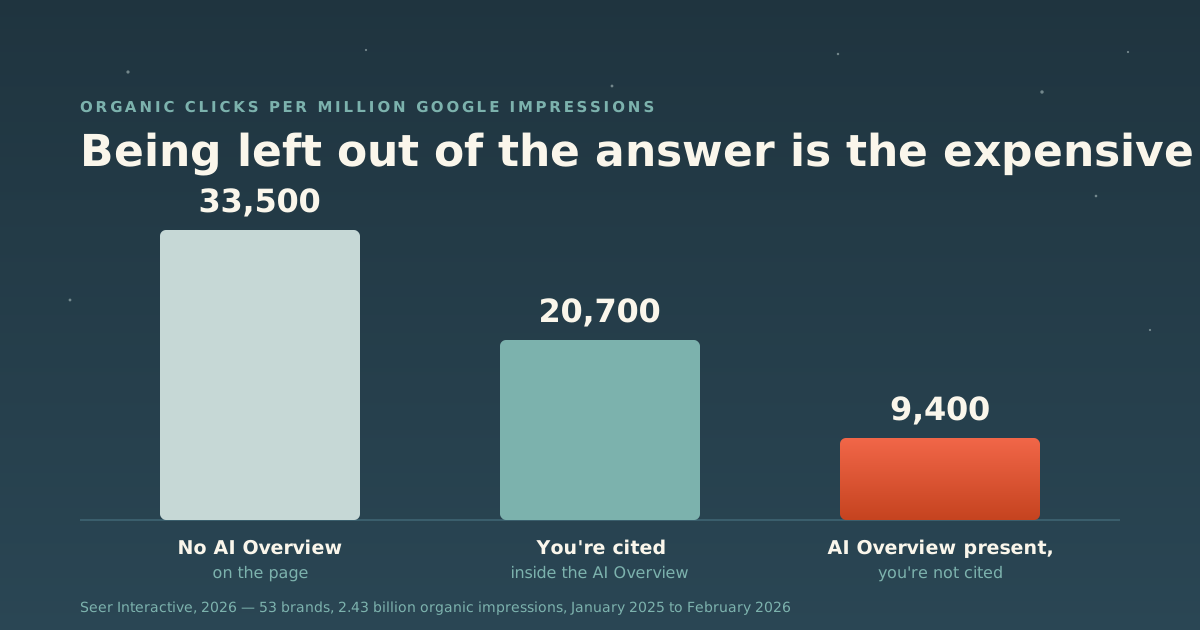
“Is SEO dead?” is the wrong question, and has been for about fifteen years. But the version people are asking in 2026 (do I still need it if the answer shows up before the links?) is a fair one, and it deserves numbers rather than reassurance.
Here’s the summary before the evidence: the click economics did change, the losses are real and unevenly distributed, and the foundation you’d build for SEO is the same foundation that gets you into AI answers. The work didn’t die. It moved.
What actually changed: the click math
The trend that predates AI got a lot worse, fast. Zero-click searches (queries that end without the user visiting any website) now account for 68% of Google searches, according to Similarweb’s clickstream data published in June 2026. A decade ago that figure was around 45%. The steepest part of that climb lines up with the AI Overview rollout.
Two independent measurements put a number on the AI-specific piece:
- Ahrefs analyzed 300,000 keywords using aggregated Search Console data, comparing March 2024 (before the US rollout) with March 2025. The presence of an AI Overview correlated with a 34.5% lower average click-through rate for the top-ranking page.
- Pew Research Center, watching what 900 US adults actually did in their browsers, found people clicked a traditional result on 8% of pages with an AI summary versus 15% without.
So: real and measurable. If your marketing plan assumed that a #1 ranking on an informational query buys the traffic it bought in 2023, that assumption is broken.
The part almost nobody reports: it partially bounced back
Here’s where most “SEO is dead” articles stop, and it’s the reason they’re misleading.
Seer Interactive’s 2026 study is the largest longitudinal look at this we’ve seen: 53 brands, 5.47 million queries, 2.43 billion organic impressions, tracked month by month from January 2025 through February 2026. It found the decline everyone reports: organic click-through on AI-Overview queries slid for eighteen straight months, bottoming at 1.3% in December 2025.
Then it reversed. By February 2026 it had climbed back to 2.4%, a recovery that beat the study’s own regression model in two consecutive months. And on queries where no AI Overview appeared, organic click-through rose over the same period, from 2.8% to 3.8%.
That second number is the one worth sitting with. On the searches AI hasn’t absorbed, clicking is getting better, not worse. The market isn’t collapsing uniformly; it’s sorting.
Where the losses concentrate, and where they don’t
AI Overviews are not distributed evenly across the kinds of searches that matter to a business. They cluster hard on informational, top-of-funnel queries (“what is,” “how does,” “why do”), which are precisely the queries where a summarized answer fully serves the user. Those are also, not coincidentally, the queries that historically produced plenty of traffic and very few clients.
The commercial end is moving, though, and pretending otherwise would be dishonest. Semrush studied 600,000+ keywords across ten industries between November 2025 and April 2026 and found the share of commercial-intent results carrying an AI Overview grew 71%, with finance up 231%. Transactional searches went the other way, down 5% overall.
The practical read: the further down the funnel a query sits, the more intact its clicks are today, and the less safe it is to assume that holds through 2027.
Why AI visibility runs on SEO, not instead of it
This is the load-bearing point, and it comes straight from the vendors rather than from an agency’s opinion.
Google’s documentation on AI features states that to be eligible as a supporting link in AI Overviews or AI Mode, “a page must be indexed and eligible to be shown in Google Search with a snippet.” There is no separate AI index. The front door is ordinary indexing.
And in its guidance on optimizing for generative AI search, Google answers the “is SEO still relevant” question with, verbatim, “In short, yes!” because “our generative AI features on Google Search are rooted in our core Search ranking and quality systems.” Its own summary of the whole topic: optimizing for generative AI search “is optimizing for the search experience, and thus still SEO.”
That single architectural fact dissolves the budget question people keep asking us. You cannot move money from SEO to AEO, because AEO is served by the pages SEO maintains. Defund the index-facing work and you defund the thing feeding the answer. What you can do is change which pages you invest in, which is a different and much more useful conversation. We cover the tactical side in how to show up in ChatGPT and AI search.
The scale question: is AI traffic big enough to chase?
Not yet on its own, and that’s an argument for keeping the foundation, not against it.
Semrush analyzed traffic to 50,000+ websites across 17 industries for all of 2025. Organic search accounted for 16.04% of traffic and generated over a trillion visits. Traffic attributed to AI systems accounted for 0.14%, while growing at 66% versus organic’s 2.4%.
Two true things at once: AI referrals are a rounding error today, and they’re the fastest-growing line on the sheet. A business that abandons search to chase 0.14% is making a bad trade this year. A business that ignores the trajectory is making a bad trade in a few.
There’s an argument that AI visitors punch above their weight: Semrush’s own study claims the average AI search visitor is “4.4 times as valuable as the average visit from traditional organic search, based on conversion rate,” reasoning that someone arriving from an AI answer has already done their comparison shopping. That’s plausible and it matches what we see anecdotally, but treat it as a vendor’s finding: the published methodology is thin, and Semrush sells tools that benefit from the conclusion. Worth knowing, not worth planning around.
Google’s version versus the field’s
Google disputes the gloomy framing. In an August 2025 post, Search head Liz Reid wrote that total organic click volume from Google has been “relatively stable year-over-year,” that “average click quality has increased,” and that Google is “sending slightly more quality clicks to websites than a year ago.” She called third-party reports of collapse the product of “flawed methodologies.”
Google published no numbers alongside those claims. The independent studies published theirs. Both sides can be partly right: aggregate clicks across the whole web can hold steady while informational publishers lose badly and commercial pages hold. We’d rather show you the disagreement than pick the version that flatters a service we sell.
So what is the job now?
| Do less of | Do more of |
|---|---|
| Thin pages targeting broad informational keywords | Pages that answer one real buying question completely |
| Volume as the success metric | Citations, qualified visits, and conversions as the metric |
| Ranking reports as the deliverable | Checking what the assistants actually say about your category |
| Keyword density and tone-of-authority tricks | Specific evidence: numbers, sources, first-hand experience |
| Treating AEO as a separate budget line | Treating it as the same pages, better answered |
The mechanics of the second column are unglamorous and mostly familiar: be reachable and fast enough that a crawler and a human both get through, pick subjects you can speak to from experience, and structure pages so the answer arrives before the throat-clearing. It’s the same craft we documented for optimizing blog posts for SEO and keyword research in an AI world.
How to decide what SEO is worth to you
Rather than accepting anyone’s industry average (including ours), measure your own situation. Three checks, all free:
- Ask the assistants your customers’ questions. Type them into ChatGPT, Google’s AI Mode, and Perplexity. Who gets cited? If it’s a competitor you could plausibly out-answer, that’s a live opportunity. If it’s nobody in your category, the field is open.
- Segment your own Search Console data. Split informational queries from commercial ones and compare impressions to clicks over the last eighteen months. Your loss curve is probably not the industry’s. Search Console is free and it’s your data, not a vendor’s model.
- Check that a machine can read you at all. If your pages render slowly or only in JavaScript, none of the above matters yet. Google’s PageSpeed Insights covers speed; our free Website Analyzer grades machine-legibility more broadly. We ran it on ourselves and published the C−, so we’re not precious about what it finds.
If those three checks say your best queries are commercial, your citations are absent, and your pages are legible, you have a straightforward AEO opportunity and a working SEO foundation. If they say your traffic was always informational and it’s evaporating, search may never have been the right channel for your offer, and no amount of optimization fixes that. Strategy comes before tactics here, as usual.
The honest bottom line
SEO in 2026 is a worse traffic business and a better qualification business than it was in 2023. Fewer people arrive. The ones who do have often already read a summary of the category, compared their options, and decided you were worth a look. That’s a warmer visitor than a curiosity click ever was.
The foundation is unchanged because it was never really about search engines: be reachable, be fast, be worth quoting, and answer the question you actually get asked. That earned rankings in 2016 and it earns citations now. What changed is that the tolerance for thin, keyword-shaped pages went to roughly zero, because a machine can already generate that content and has no reason to send anyone to yours.
If you want a partner who’ll tell you when the honest answer is “that query isn’t worth chasing anymore,” that’s the work we do.