


“Free guide” is not a lead magnet idea. It’s a format with nothing in it yet.
The ideas that work share three traits. They name a specific problem. The person can use them this week. And they attract people you can actually serve, because the offer decides who ends up on your list. Everything below is organized around what you want the magnet to do, since that decides the format more than your topic does.
This is the companion to our guide on how to grow your email list, which covers the forms, the rules, and the arithmetic. This piece is about the offer itself.
What makes a lead magnet work?
Run every idea through three tests before you build it:
- Does it name a problem? “Updates from my practice” doesn’t. “The 12 questions I ask on every discovery call” does.
- Can they use it this week? If the honest answer is “they’ll save it for later,” it will be forgotten along with you.
- Does it sit directly upstream of what you sell? A magnet about Instagram growth builds a list of people who want Instagram growth. If you sell executive coaching, that list is an audience you can’t serve.
The third test is the one people skip. The magnet trains your list. It tells subscribers what you’re about and tells you what they wanted, so everything you email afterwards should build on it.
The menu: 13 ideas in four families
| Family | Ideas | Effort to make | What you learn about the lead |
|---|---|---|---|
| Quick wins | Checklist, template, cheat sheet, curated resource list | Days | Only which topic they chose |
| Things that teach | Email mini-course, video series, challenge, short guide | Weeks | How far they got |
| Things that diagnose | Quiz, assessment or scorecard, free tool or calculator | Weeks, or a build | Their situation, in their own answers |
| Live formats | Webinar or workshop, virtual summit | Prep, then it repeats | That they gave you an hour |
Quick wins
These are the fastest honest start, and the right first magnet for most people who don’t have one.
- A checklist. The steps you’d walk a client through, in order. Works when your expertise is a process.
- A template or swipe file. The actual document: the email, the agenda, the intake form, the budget sheet. People value it because it saves them a blank page.
- A cheat sheet. One page of the decisions or numbers you get asked about most.
- A curated resource list. The tools, books, or suppliers you actually recommend, with a sentence on why. Credible only if it’s honest about what each one is bad at.
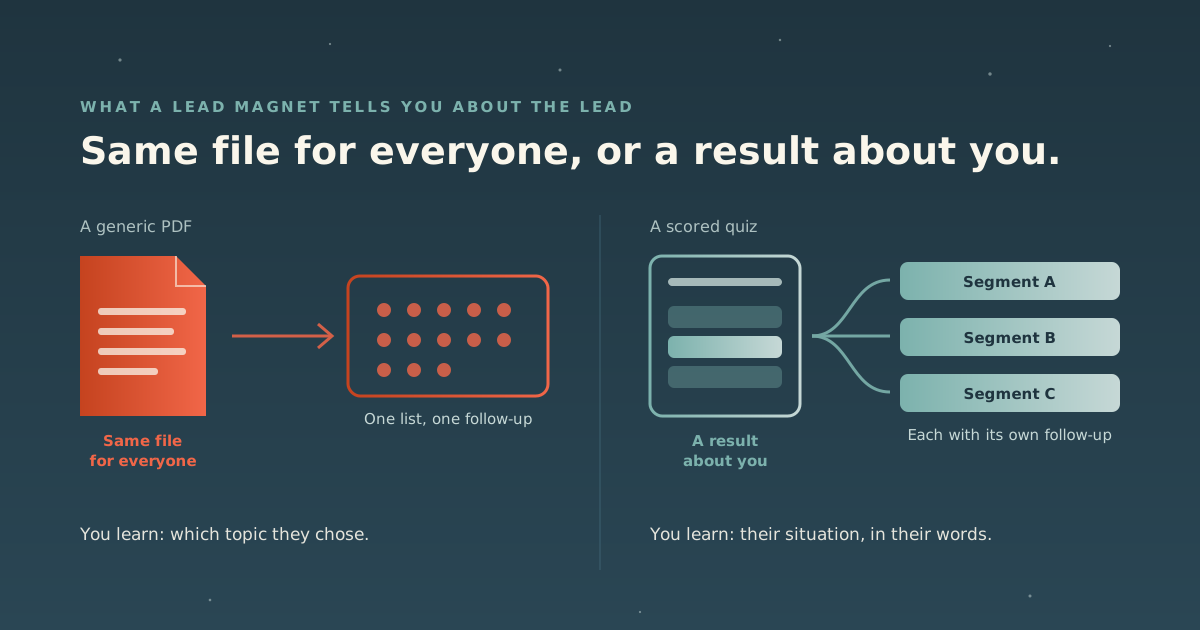
The weakness they share: everyone gets the same file, so you learn almost nothing about who downloaded it.
Things that teach
Teaching formats take longer to make and build more trust, because the subscriber spends real time with your thinking before they ever hear an offer.
- An email mini-course. Five to seven short lessons, delivered as a sequence. It doubles as your welcome sequence, which solves the “they subscribed and heard nothing for three weeks” problem. For Sonia Choquette, a mini-course lead magnet delivered as a drip sequence was part of the lead engine we built ahead of her biggest launch.
- A short video series. The same idea on camera. Better when your delivery is part of what people buy.
- A challenge. A fixed number of days, one small action each day. It suits anything that depends on a habit. For the UC Davis habit-change community, the free 21-Day Plant-Based Challenge alone added more than 21,000 people to the email list.
- A short guide. The classic PDF, done well. Design matters more than people think: when we rebuilt JeffWalker.com, his “16 Rules of Internet Success” lead magnet got a premium design, because a flimsy PDF would have undercut his authority at the first opt-in.
Things that diagnose
This family sits behind several of our strongest client results. A diagnostic gives each person a result about their own situation, and it tells you who they are while it does.
- A quiz. Lighter, often personality- or type-based. James Van Praagh’s free Spiritual Archetype quiz and the personality quiz we built for Wonders of Wisdom both work this way: an evergreen front door that runs between launches.
- An assessment or scorecard. Scored against criteria that matter, with a ranked result. The Exit Strategy Coach scorecard takes three minutes, scores a business out of 60 across six value drivers, and returns the three highest-priority areas to improve. Seven days after it went live, Michael Morrissey had signed two high-end coaching clients.
- A free tool or calculator. It does a job the person would otherwise do by hand. Our own Website Analyzer and Launch Planner are this kind of magnet (more on how we gate them below).
Live formats
- A webinar or workshop. The warmest subscribers there are, because they have already spent an hour with you before they hand over an address. Our own webinars exist partly for this reason.
- A virtual summit. Many experts, one free pass. It’s a big undertaking, and it can reset the top of the funnel. The Soil Regen Summit we proposed and built for Soil Food Web School offered free access to 60+ sessions, brought in registrations at roughly a dollar each, and left a recorded collection that kept generating leads after the live event.
Which lead magnet fits your business?
A starting point by audience. These are defaults, not rules:
| If you are a… | Start with | Graduate to |
|---|---|---|
| Coach | A checklist or template for the exact problem your program solves | A scored assessment that ends in a booking link |
| Speaker | A recording or excerpt of a signature talk, plus its one-page framework | A live workshop version of the talk |
| Author | A sample chapter or the book’s central framework as a worksheet | A challenge or mini-course built on the book |
| Consultant | A diagnostic scorecard for the problem you’re hired to fix | A free tool that does part of the diagnosis |
| Nonprofit | A practical guide or toolkit for the people your mission serves | A challenge or course that turns readers into participants |
Why a diagnostic can do more than a PDF
A generic PDF hands everyone the same thing and tells you nothing. A scored quiz gives someone a result about their own situation and gives you a segment. That’s the difference, and it compounds: the lead feels seen rather than processed, and you can route them to the follow-up that fits instead of one undifferentiated list.
The clearest example we have is Soil Food Web School. Its top of funnel ran on three quizzes (Compost IQ, Soil Biology IQ, and a Soil Health Assessment), built in Typeform with scoring logic and dynamic reports. They produced leads at about a dollar each, became the business’s most profitable acquisition route, and returned about 3.7× on ad spend across their lifetime. The list grew from under 3,000 to more than 400,000 over the engagement, with paid media, a summit, and SEO also feeding it.
Two ways to build one:
- Off the shelf. Typeform supports scored quizzes and outcome quizzes out of the box. Know that it bills by volume: as of September 2026 its plans ran from a few dozen dollars a month for around 100 responses to several hundred a month for high volume (ballparks; prices are subject to change). A popular quiz is exactly what makes it expensive, so check the tier against the volume you hope for, not the volume you have.
- Custom. Build the assessment on your own site. That removes the per-response meter and keeps the data in your hands, and it can go further: the Michel Peruch diagnostic is a 15-question assessment that produces an AI-written Executive Brief for every submission, with a 90-day action plan of three prioritized moves. It’s a build rather than an afternoon. That’s the AI-powered lead gen work we do.
Should you gate it?
Here’s the trade most lead magnet advice skips. Google’s documentation on lazy-loaded content is blunt: Google Search does not interact with your page. Don’t count on it filling in your form and clicking submit to reach what’s behind it. Treat anything behind the form as invisible to search. That matters more now that AI assistants cite pages directly. A gated guide can’t be quoted, however good it is (we covered why in how to show up in ChatGPT and AI search).
The middle path we use ourselves: publish the substance, gate the convenience. Our Website Analyzer shows your report card free, with no account, and emailing it is optional. The Launch Planner shows the whole roadmap before asking for anything. People who want the emailed copy, or the working version they can tick off, hand over an address because they want it, not because they were stopped at a wall. Those are better subscribers.
What to gate: the downloadable template, the personalized report, the full course, the recording. What to leave open: the idea.
How to deliver it so the subscriber sticks
The gap between “subscribed” and “heard from you” is where lists rot. Four rules:
- Deliver by email, not only on the thank-you page. It confirms the address is real and gets your name into their inbox from a message they wanted.
- Use the thank-you page for one next step. They’re paying attention right then. A short video, a booking link, or the most useful article you’ve written. One thing, not a menu.
- Tag by magnet. Record which magnet each subscriber came in through, so you know what they asked for. Kit is built around exactly this idea: a subscriber is a person with tags, not a row in a list.
- Start the follow-up immediately. The first three emails matter most. Our email list guide has the minimum viable three-message version.
You probably don’t need a separate landing-page tool to host the opt-in. Most email platforms now build decent landing pages, which is the main reason we reach for LeadPages less than we used to. For the magnet itself, Canva is enough to make a guide or checklist look designed, as long as you load your brand kit instead of shipping the template untouched.
On consent. The UK regulator, the ICO, says it may be possible to incentivise consent to some extent. Its own example is a loyalty scheme that comes with money-off vouchers. It also says you must not unfairly penalise people who refuse, that consent should not be bundled up as a condition of service unless it is necessary for that service, and that pre-ticked boxes don’t count. The safe practical habit anywhere: say on the form, in plain words, that subscribers will get emails from you, and make leaving easy.
Lead magnet mistakes that cost you subscribers
- Too broad. “The ultimate guide to growing your business” fails the first test. Narrow it until it names one problem.
- Too long. Length is a price the subscriber pays before getting anything back. Cut until it can be used in one sitting.
- Mismatched to the offer. A magnet that attracts people you can’t serve grows the wrong list, and you pay for every contact on it.
- A gimmick instead of an answer. Discount wheels and giveaways attract people who came for the prize.
- Silence afterwards. The magnet opens the relationship. If nothing follows, you’ve given away your best material to people who’ll forget where it came from.
How to choose yours this week
- Write down the problem your paid work solves, in the words a client would use.
- Pick the smallest thing that helps with that problem before they hire you.
- Choose the family: a quick win if you need something live this week, a diagnostic if you want to know who each lead is.
- Build it, deliver it by email, and write the first three follow-up messages before you promote it anywhere.
If your practice runs on conversations, the diagnostic is usually worth the extra effort. It’s the only format that does part of the discovery call before the call. For more on where those conversations come from, see how to get more coaching clients. If you want the whole path built (the assessment, the delivery, the follow-up and the handoff), that’s our sales funnel and lead gen work.
Sources: ICO: What is valid consent? · Google Search Central: Fix lazy-loaded website content · Typeform: Plans and pricing