


We’re a marketing agency that works with speakers and authors, so read this with that in mind. We know the speaking world well: the National Speakers Association hired us for its own marketing and product launches. Everything below is drawn from projects we’ve published case studies on, linked so you can check.
The authority gap
Some of the most credible experts we meet barely exist online. They’re invited to stages, quoted in the press, trusted by corporate clients, and they’ve written books. But when an event planner searches their name, or someone asks ChatGPT who to hire on their topic, what comes up is thin: an old site, a few scattered interviews, and other people’s articles.
That’s because offline authority lives in rooms and publications you don’t control. Online visibility has to be built on pages and channels you do control, and kept up.
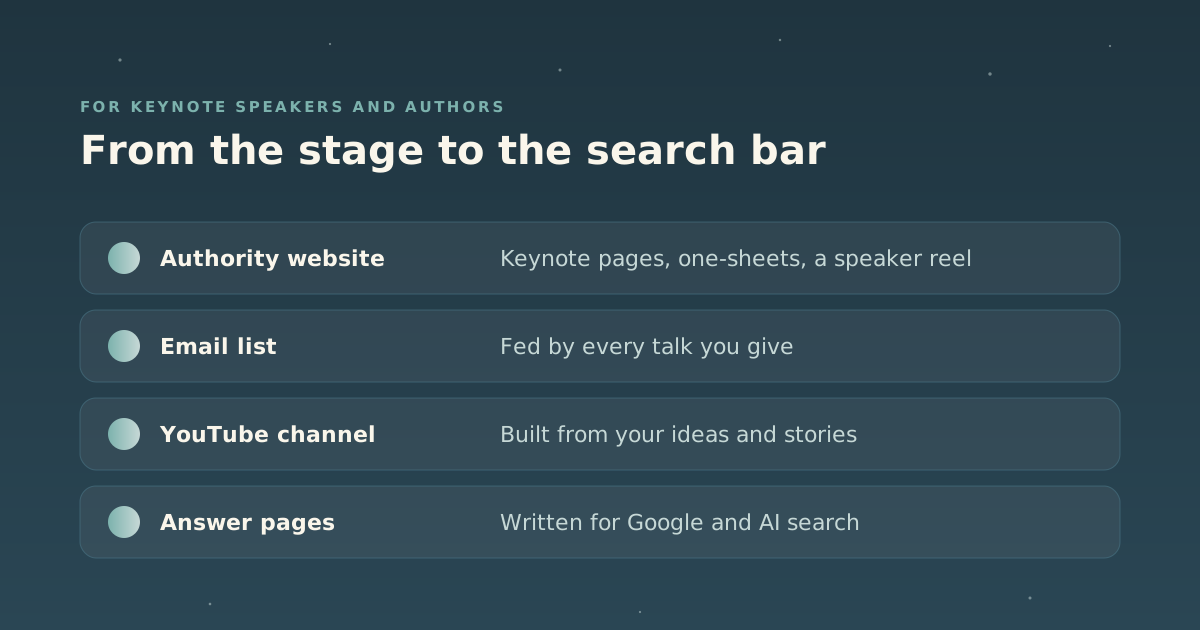
Four things that close the gap
| What to build | What it does |
|---|---|
| An authority website | Gives planners, buyers and readers one credible place to check you |
| An email list fed by every talk | Turns each audience into people you can reach again |
| A YouTube channel built from your ideas | Lets people see you speak before they book you, and ranks in search |
| Answer pages for AI search | Gives Google and AI assistants clear, quotable answers to cite |
1. An authority website built for the people who book you
For Super Bowl champion and executive coach Jimmy Farris, we started from a brand identity book that covered everything from photoshoot direction to keynote slide design. Then we built a site where each keynote has its own page with downloadable one-sheets for event planners, plus a professionally produced speaker reel that shows how he comes across on stage before anyone sees him live.
For CEO advisor Michel Peruch, the site opens with a 15-question diagnostic. Each submission gets a written recommendation, and every path leads to booking a call with him.
2. An email list that every talk feeds
Most audiences hear you once, unless you give them a way to stay in touch. Offer a free resource tied to each talk, from the stage and on that talk’s page, then keep in touch. Jimmy’s site feeds an 18-month automated sequence with a weekly dose of his stories and frameworks. When we rebuilt Brendon Burchard’s site, we wired in list-building infrastructure his team can use to spin up new opt-ins in minutes.
3. A YouTube channel built from your ideas
Video lets planners and buyers see you before they book you, and it ranks in Google and gets cited by AI assistants. While we ran bestselling author and speaker Sonia Choquette’s channel, it grew from about 15,000 to 335,000 subscribers, and her videos now lead Google’s video results for her name.
4. Answer pages for AI search
People now ask AI assistants which speaker, author or advisor to hire. Those tools cite pages that answer the question clearly. Write pages around the questions your buyers actually ask, keep your bio and credentials consistent everywhere, and give every video a transcript and its own page on your site.
Sell something to the audience you build
Visibility pays off when there’s a next step for the people who find you: a program, a workshop, a certification, a book. With Brendon Burchard we produced Elevate Your Brand, an implementation week where 25 thought leaders left with live, branded websites and lead funnels. For Jeff Walker, with a major book launch 10 days out, we rebranded and relaunched his site in time.
What it costs
Our Authority Site is $16,500, one time, including copywriting and three months of care after launch. Our YouTube Accelerator is $3,995 a month for 2 videos and 6 Shorts, or $5,995 a month for 4 videos and 12 Shorts, plus a $2,995 setup and a six-month minimum. See the full website cost guide and YouTube cost guide for how those compare with doing it yourself or hiring a freelancer.
What we don’t do
We don’t book stages or place press. Many of our speaker clients work with a speakers bureau or publicist alongside us, and we build what those introductions lead people to. We’ve also worked with the National Speakers Association on its own marketing and product launches.
Is it the right time?
If more of your week goes to editing, posting and wrestling with your website than to speaking, writing and client work, read when to hire a marketing agency. You can also see how we work with coaches, consultants and speakers and with authors.