


Quizzes and self-assessments are what we build most for coaches, authors and spiritual teachers, and they’re bringing in leads at a strong cost per lead right now. This guide covers why they work, what AI changed, and how to build one. If you’re still choosing a format, start with our email list building ideas for coaches, which compares quizzes with guides, webinars, courses, tools and challenges.
Why quizzes build lists
Every visitor to your site is quietly asking “what’s in it for me?” Most lead magnets answer with a promise. A quiz answers with something about the visitor: their type, their score, where they’re stuck.
That makes it intriguing. People want to know their result, in the same way they finish a personality test they found by accident. And when the report is done really well, it meets people where they are. Someone who learns that their strongest gift is clairsentience, or that their business is losing value in two specific areas, feels understood before they’ve spoken to you.
It also works for you. A guide tells you only that someone downloaded it. A quiz tells you how they answered, so you can follow up with what fits them and walk into a discovery call already knowing their situation.
What AI changed
We used to build quizzes with fixed logic in tools like Typeform. Each answer added points, and everyone who scored in a range got the same result page. They worked well, but a result page written for a few hundred people can only be so personal.
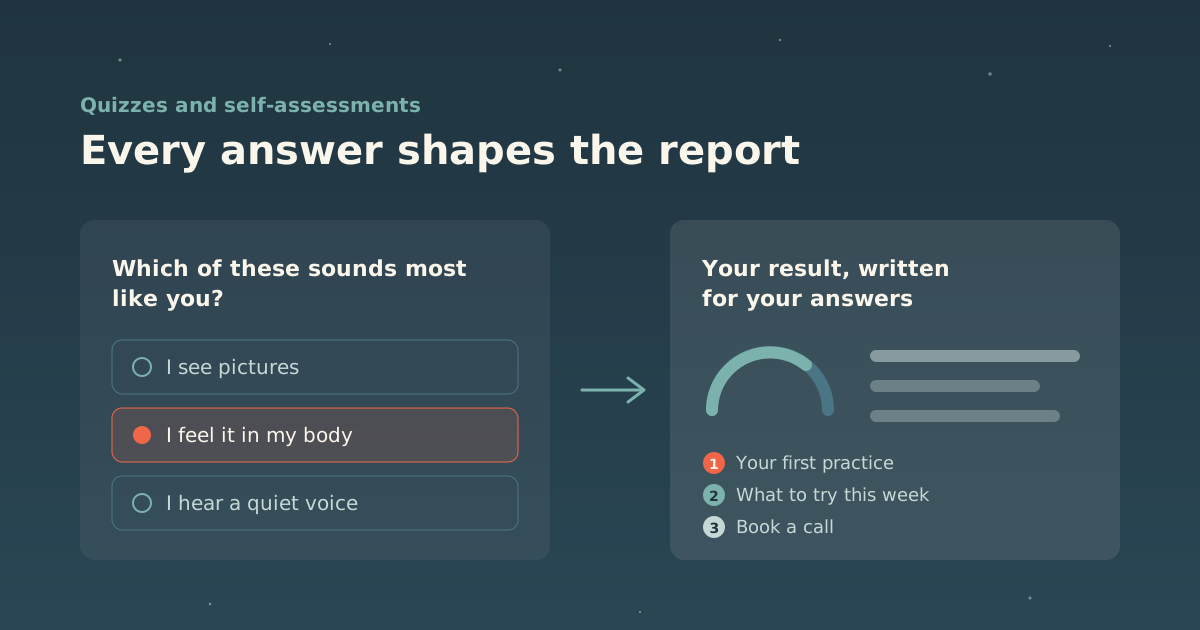
Now AI can write each person’s report around the answers they actually gave. Think of it as the assessment we always wanted to build, with far more horsepower behind it. Two people with the same score get different reports, because one is strong on systems and weak on sales while the other is the reverse. That makes the result far more valuable to the person who took it, which is the whole point of a lead magnet, and it’s why we’re leaning hard into assessments.
For CEO advisor Michel Peruch, each of his 15-question Business Diagnostic submissions produces a written Executive Brief: a plain-English diagnosis, pillar-by-pillar comparisons and a radar chart. No two reports read the same, and every path ends in booking a call with him.
Examples from our clients
Rebecca Campbell’s “Where have you spent a past life?” quiz
For bestselling author Rebecca Campbell, a quiz asking “Where have you spent a past life?” ran at the front of her Discover Your Cosmic Blueprint campaign, run in partnership with her publisher, Hay House. Two lead magnets ran before the launch: a meditation and the quiz. The quiz did far better, on cost per lead and on overall return.
A meditation is a fine gift, and it suits her audience. The quiz won because it promised something about the person taking it.
Sonia Choquette’s “What is your strongest clair?” quiz
For Sonia Choquette, we built a quiz on the clairs: clairvoyance (seeing), clairsentience (feeling), clairaudience (hearing) and the others. People who are curious about intuition want to know which one is theirs, and the result gives Sonia a natural next step: a course or practice for developing that gift. Similar type quizzes run for James Van Praagh (a Spiritual Archetype quiz) and Wonders of Wisdom (a personality quiz that leads to a low-priced first offer).
Soil Food Web School’s quizzes
The Soil Food Web School ran three quizzes: Compost IQ, Soil Biology IQ and a Soil Health Assessment. They were built in Typeform with scoring logic and dynamic reports, so people got real feedback on their own soil. They became the school’s most profitable way to find new students, bringing in leads at about a dollar each at scale, and returning about 3.7 times their ad spend over their lifetime. Over our four years together the email list grew from under 3,000 to more than 400,000, with the quizzes leading that growth alongside paid media, an annual online summit and SEO.
Three assessments for coaches and advisors
- Dr. Marina Capella, a double board-certified physician, offers physicians a free self-assessment called “What did medical training cost your spirit?” Fifteen questions across five areas give a score right away, and an email address brings the full report with the three practices to start with.
- Exit Strategy Coach has a three-minute scorecard that rates a business out of 60 across six value drivers and returns the three areas costing the most at sale. We took it from idea to live in one day, and Michael Morrissey signed two high-end coaching clients within seven days.
- Michel Peruch’s Business Diagnostic, described above, is the front door of his whole site.
How to build one
Start with the problem you’re paid to solve
The quiz should sit directly upstream of your offer. If you coach executives through burnout, the assessment measures burnout. A fun quiz about something unrelated builds a list of people who wanted the fun quiz.
Decide what you want to learn about each person too. For a high-ticket offer, that’s usually how serious the problem is, what they’ve tried, and whether they’re ready to act.
Write questions people can answer quickly
- Ask about behavior and situations, which people can answer honestly, more than opinions about themselves
- Keep each question to one idea, with answers that don’t overlap
- Use the words your clients use, not your framework’s labels
- Ask only what changes the result or tells you something you’ll use
Our recent assessments range from 15 questions taking about seven minutes to 30 quick statements in about three minutes. Rated statements (“not true, somewhat true, fully true”) are fast to answer and easy to score.
Choose your result type
A type quiz sorts people into a few profiles, which is light, shareable and good at the top of a spiritual or personal-growth funnel. A scored assessment gives a number against criteria that matter and ranks what to fix, which suits coaches and advisors selling a specific outcome. Either way, give each result a name people would want to repeat.
Make the report worth reading
The report is the lead magnet, so most of the effort belongs here. A good one:
- Names the person’s result in plain words
- Explains what that means for them, using their own answers
- Ranks two or three priorities, with something they can do this week
- Shows who you are and why you can help, without a hard sell
- Ends with one next step, such as a booked call, a course or a workshop
We usually show a short result on screen (the score and the profile name) and send the full report by email. People get something real first, and the ones who want the rest are glad to give their address.
Follow up based on the result
Tag each subscriber with their result, then send emails that build on it. Someone who scored low on visibility should hear about visibility. The first email delivers the report, the next few teach around their result, and then you make one clear offer. For Dr. Capella, everyone who books a consult is tagged so the emails stop inviting them.
Bring people to it
Link the quiz from your best articles, YouTube descriptions, podcast appearances and social profiles. Then promote it with ads. Quizzes do well on Facebook and Instagram because the ad can ask the question directly: “Which clair is strongest in you?” Our guide to what Facebook ads cost coaches has the published benchmarks to plan a first budget against.
Judge the ads on what happens after the quiz, such as booked calls, applications and sales, not only on the cost per lead. And keep people’s answers private. For Dr. Capella’s assessment, tracking is set up so that nobody’s answers or results ever reach an ad platform, which matters when the questions touch on health or personal struggles.
Build it yourself or get help
A simple scored quiz is a weekend project in Typeform, which handles scoring and outcome quizzes out of the box. Its pricing is per response, so check the plan against the volume you hope for, not the volume you have.
A custom assessment on your own site, with AI-written reports, tagged follow-up emails and ad tracking, is a bigger build. That’s our AI-powered lead gen work, and we build it for coaches and certification programs. If the quiz will feed a launch, our course launch cost guide shows what the rest of the launch costs.