


We’ve been building lead magnets for coaches, authors and teachers since 2008. This is the short list of what we’ve seen work, with the client examples behind each one. For a longer menu of formats, see our lead magnet ideas guide.
What a lead magnet is, and why it works
Think about the free samples at Costco. You taste the meatballs or the new snack, your kids look up at you hopefully, and it happens to be on sale. A sample works because you’ve already had a bite.
A lead magnet is the same idea for your expertise. It’s something free that gives people a taste of how you think, whether they can trust you, and the results you help people get. A good one improves their life a little, and that creates reciprocity: you gave first.
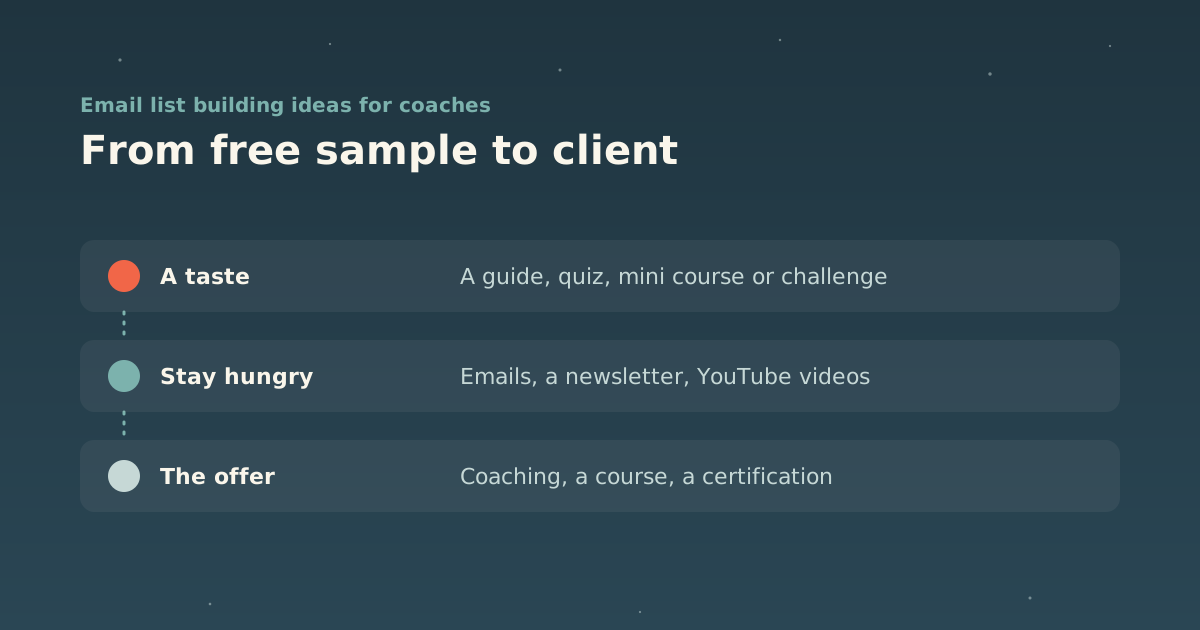
Some share of the people who take the sample stay hungry. They keep reading your emails, watch your YouTube videos, and look at your offers more closely as you keep in touch through welcome emails, automations and a newsletter. That’s the path from stranger to client:
| Stage | What they’re doing | What you give them |
|---|---|---|
| Top of the funnel | Meeting you for the first time | The lead magnet |
| Middle | Deciding whether you’re for them | Welcome emails, a newsletter, your videos |
| Bottom | Deciding whether to buy | The offer, a call, an application |
The lead magnet only opens the door. The emails behind it do most of the selling, so plan both. Our guide to growing your email list covers the forms and the follow-up in detail.
1. A free guide or ebook
The guide has always been there. It descends from the corporate white paper: a document that shows you understand a problem better than anyone else in the room.
It’s still the easiest lead magnet to make, and it works when it names one problem and solves it. “The 12 questions to ask before you hire a business coach” will beat “My guide to a better life” every time. Its weakness is that everyone gets the same file, so you learn very little about who downloaded it.
2. An evergreen webinar
An evergreen webinar is a recorded presentation, available on demand, that teaches something useful and then invites people to the next step: a call, an application or an enrollment page.
In our experience it costs more per lead than a guide or a quiz, because asking someone for most of an hour is a bigger ask than a download. The leads are better, though. Someone who watched you teach arrives at a discovery call already knowing how you work. For high-ticket offers and for businesses that sell on calls, that trade is often worth it. Structure matters: teach a real idea, show proof, then make one clear offer.
3. A course or mini course
A short course teaches the first step of what you do, and the full program is the natural next step.
With Sonia Choquette we built a free mini course called “3 Secrets to Becoming a Highly Paid Intuitive Coach and Guide.” Thousands of people joined her list through it, raising their hand to say they wanted to develop an intuitive coaching or healing practice, and to learn from someone with a proven track record. The course then nurtured them toward her coach certification, The Gifted Intuitive Coach. Together with targeted ads, that lead engine built a webinar list of more than 25,000 registrants for the biggest launch in Sonia’s history.
A mini course delivered by email also doubles as your welcome sequence, so new subscribers hear from you right away.
4. A quiz or self-assessment
This is Peaceful Media’s core competency, and it’s where we’re leaning in hardest right now.
A quiz answers the question every visitor has, “what’s in it for me?”, with a result about their own situation. We used to build quizzes with fixed logic, where everyone who scored in a range got the same result page. Now AI can write each person’s report around the answers they gave, which makes it far more valuable to them. For the Soil Food Web School, scored quizzes became the most profitable way it found new students, bringing in leads at about a dollar each, at scale, while the list grew from under 3,000 to more than 400,000.
For coaches it has another advantage: it does part of the discovery call before the call. We wrote a full guide to using a quiz or self-assessment to build your email list, with examples, question design and the follow-up emails.
5. A calculator or planning tool
A free tool does a job the person would otherwise do by hand, and it shows your expertise by doing it.
We run two of our own. The Launch Planner helps you pick what you’re launching (a YouTube channel, a website with a sales funnel, or a course, certification or membership) and maps it into a dated project plan: what to build, who does it, and by when. The Website Analyzer grades a website across six areas of health and performance (speed, SEO and AI search, design, conversion, trust and accessibility) and names the top fixes. Both show the result free, and emailing it is optional, which is how we prefer to run a tool.
For a coach, the same idea might be a calculator for what a client’s problem costs them each year, or a planner that turns your method into a schedule.
6. A challenge
A challenge is a fixed number of days, with one small action each day, done alongside other people.
For UC Davis, the plant-based nutrition program ran challenges before its course launches: five- and ten-day challenges, and the 21-Day Plant-Based Challenge, which on its own added more than 21,000 people to the email list. A challenge creates a shared event with a beginning and an end, which makes it especially useful before a membership launch. People need to feel the community’s value and vibe, see early results, and trust the teacher before they’ll join, and before they’ll keep paying.
Challenges take much more work than a guide or a quiz: daily content, a community to host, live sessions and an email for each day. For a membership, though, few things give a better taste.
7. The newsletter as the reason to sign up
“Join my newsletter” is everywhere now, and it’s worth less every year. A stranger has no idea what they’ll get or why it matters to them.
Newsletters can still be the main draw. James Clear’s weekly 3-2-1 newsletter is the example everyone points to. That works because people already know his name and his book. Without a big name, offer something more specific than a newsletter: an answer to the exact problem your prospect has. Then let the newsletter be what they keep getting afterwards.
Which one to start with
| If you… | Start with |
|---|---|
| Need something live this week | A short guide or checklist for the problem your coaching solves |
| Sell on discovery calls | A quiz or self-assessment that ends in a booking link |
| Sell a high-ticket program or certification | An evergreen webinar, or a mini course that leads to it |
| Are launching a membership or community | A five-, ten- or 21-day challenge |
| Have a method people could plan with | A calculator or planning tool |
Whichever you pick, three things decide whether the list turns into clients:
- The lead magnet sits directly upstream of what you sell
- The first emails go out the moment someone signs up
- Something brings new people to it every week, whether that’s your content, guest appearances or Facebook and Instagram ads
If you’re planning the launch the list will feed, our course launch cost guide shows what each part costs. And if you’d like the lead magnet, the emails and the ads built for you, that’s our sales funnel and lead generation work. See how we work with coaches and certification programs.