


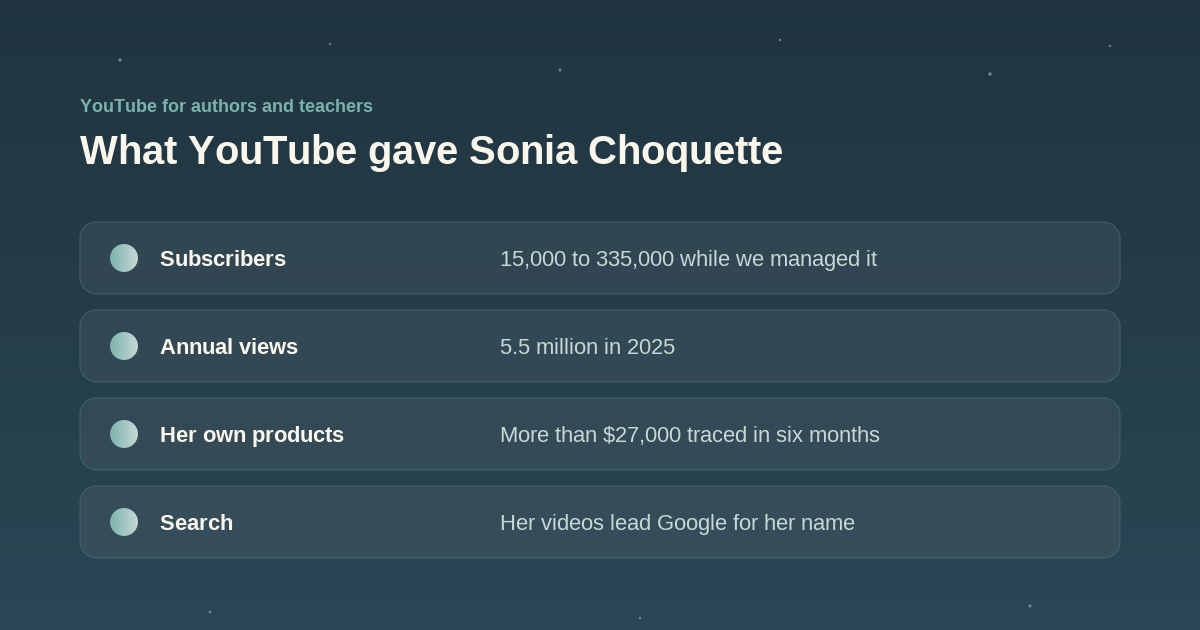
For an author or spiritual teacher, YouTube asks a lot: steady uploads, time on camera, and a year or more before it pays off. When it works, it becomes the place most new readers and students first meet you. This article covers what it can bring, using the channel we’ve run for intuition teacher and bestselling author Sonia Choquette, and how to tell whether it’s right for you.
What YouTube brought Sonia Choquette
| What | Result |
|---|---|
| Subscribers | From about 15,000 to 335,000 while we managed the channel |
| Views | 5.5 million in 2025 |
| Sales of her own products | More than $27,000 traced to YouTube in one six-month window |
| Search | Her videos lead Google’s video results when people search her name |
The typical video on her channel had about 3,200 views before we started in May 2021. With topics and titles planned around what people search for, it rose to about 15,000. After we added post-production in July 2023, it rose to about 28,000. Our article on how long it takes to grow a channel goes through each stage. The subscriber, view and sales figures come from the case study and our channel reports; the typical views per video were read from her public channel in November 2026.
What YouTube gives an author or teacher
New people who don’t know you yet
YouTube recommends videos to viewers based on what they watch and search for. Someone looking up “how to trust your intuition” can find Sonia’s video on it without having heard of her. Books and talks rarely reach people that way.
Trust before they buy
A reader deciding on a course or a reading wants to know how you teach. Hours of free teaching on YouTube answer that better than any sales page. That’s why the channel drove sales of Sonia’s own products, and not only ad revenue.
A stronger presence in search
Google’s results pages increasingly include video. When people search Sonia’s name, her videos lead the video results, beside her books.
Ad revenue, eventually
Ad revenue only becomes meaningful once views are steady. For Sonia it became a real income source after we added post-production, about two years after we started. Treat it as a bonus.
Teaching that lasts
The Soil Food Web School, a regenerative agriculture school, shows another side. Its most-watched videos are teaching videos from our first year on the channel, which answer basic questions people search for. One on weed suppression has 1.7 million views. Teaching like that keeps finding new students years after it’s posted.
When YouTube is worth it
- You have a body of teaching you can share in ten- to thirty-minute pieces
- You can publish weekly, or have a team that makes it possible
- You’re comfortable on camera, or willing to get comfortable
- You have something to offer viewers: books, courses, readings, a certification or a community
- You can give it at least a year
Should anyone skip it?
Almost nobody, in Jason Miller’s view. Most people who skip YouTube talk themselves out of it.
A lot of people skip YouTube because they think they have to look and sound a certain way, as if there’s a one-size-fits-all YouTube personality who’s always vibrant and beautiful. Today people want someone they can relate to: authentic, unique, comfortable in their own skin. That doesn’t come out of the gate. You get more comfortable as you do it. So I don’t think there’s anybody who should skip it.
Jason Miller, founder of Peaceful Media
What matters more than polish is timing and readiness:
- If you can’t commit to regular uploads yet, plan for when you can. An irregular channel rarely grows.
- If you have nothing to offer the people who find you, start an email list alongside the channel so you can keep in touch until you do.
Getting help
We run YouTube channels for authors, teachers and schools: topic research, titles, thumbnails, editing and post-production. See how we run YouTube channels, what YouTube help costs or our comparison of YouTube agencies for authors and coaches.
Writing a book? Read when an author should start building an audience.