


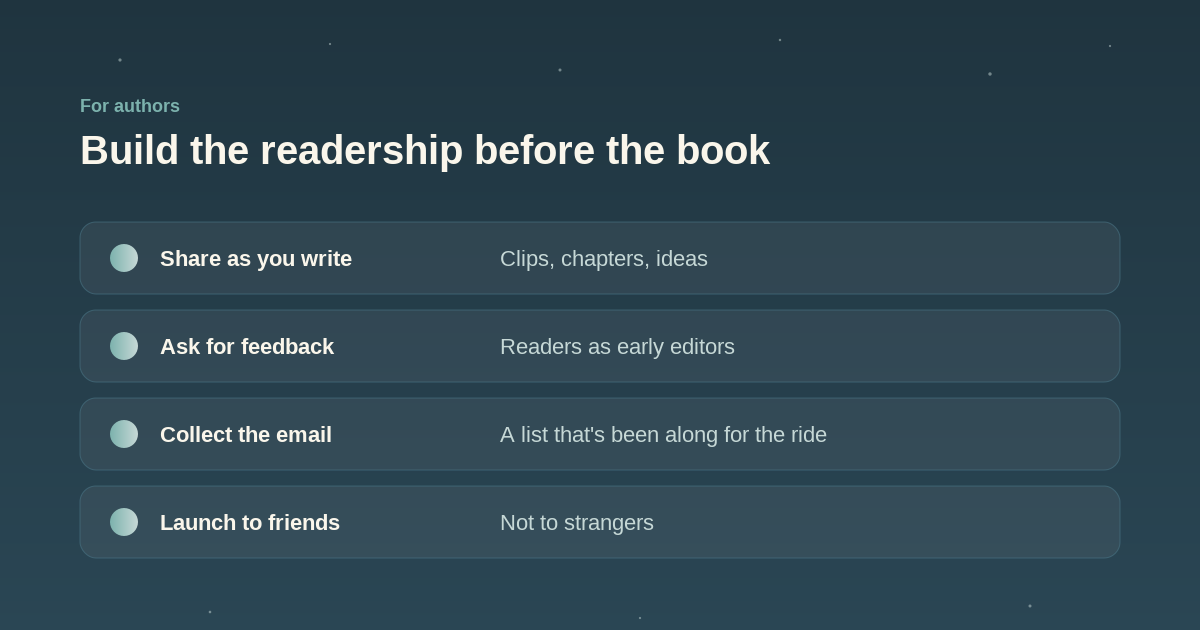
Most authors start thinking about marketing when the book is nearly done. By then, the people who would have been its first readers could have been following along for years. We asked Jason Miller, who founded Peaceful Media and co-wrote a book published by Simon & Schuster, when an author should start.
Now. Better yet, ten years ago. Your book sales start well before the first word is written.
Jason Miller, founder of Peaceful Media
How Project Everlasting built its readership
Jason and his co-author Mathew Boggs wrote Project Everlasting about what makes a marriage last, built on interviews with long-married couples. They shared the work as they went.
We took people along for the journey, sharing our interview clips with married couples on our website, and eventually on the local news and then the Today Show. That was all before we even had a publishing deal with Simon & Schuster or an agent. By the time the book was on shelves, we’d built an email list of 10,000 people who’d been along for the ride with us, and that was before social media was a thing.
Jason Miller
Those 10,000 people weren’t strangers being pitched a book. They had followed it from the first interviews, and they were waiting for it.
Share it freely
Many authors keep the book under wraps so people will buy it to find out what’s inside. Jason sees it the other way round.
If we were launching a book today, we’d be sharing across every social channel, and no non-fiction content would be off-limits. Share it freely and publicly in email newsletters and social posts. Get feedback from your audience before it gets burned into fibers and Kindles. Look at authorship as co-creation with your eventual buyers.
Jason Miller
People who see themselves as part of the book’s journey buy it, recommend it and stay loyal in a way that’s hard to earn with a pitch. And their responses show you which ideas land before they’re printed.
What to share while you write
- Stories and ideas from the book, as short posts and videos
- Interviews or research, if the book is built on them
- Draft chapters or passages, with a question for readers
- What you’re struggling with in the writing, and what you’ve changed
- A newsletter that gathers it all, so you own the relationship
Marina Capella, a story in progress
Dr. Marina Capella, a pediatrician and integrative physician, is writing her first book, Awakening the Healer’s Soul, for physicians facing burnout. The book isn’t finished, and the launch is a long way off, but the readership is already being built:
- A YouTube channel we started from zero, now at 737 subscribers, with each long video turned into a newsletter email and its Shorts into Facebook Reels
- An email list of 677 people, built from her own network of about 630 fellow pediatricians and growing with sign-ups from her free self-assessment for physicians, which sends follow-up emails matched to each person’s answers
- A book section on her site with a cover concept and a mailing-list sign-up
Starting with the people who already know you, then widening the circle, is a sound way to begin. There are no pre-orders or sales to report yet, and we’ll track the results as the book gets closer. Read the Marina Capella story for how the platform was built.
Getting help
We build author platforms ahead of the book: the website, an email list with a lead magnet, a YouTube channel and social content. See marketing for authors, whether YouTube is worth it for an author, or how speakers and authors turn offline authority into online visibility.