


Many coaches who start a YouTube channel stop within a few months, often just before it would have started to work. This article covers what a realistic timeline looks like, using two channels we’ve run: intuition teacher and bestselling author Sonia Choquette, and the Soil Food Web School.
A note on the numbers: they’re lifetime views per video, read from each public channel in November 2026. Older videos have had longer to collect views, so we compare typical (median) videos across periods rather than claim growth over a set number of months.
Sonia Choquette’s channel, in three stages
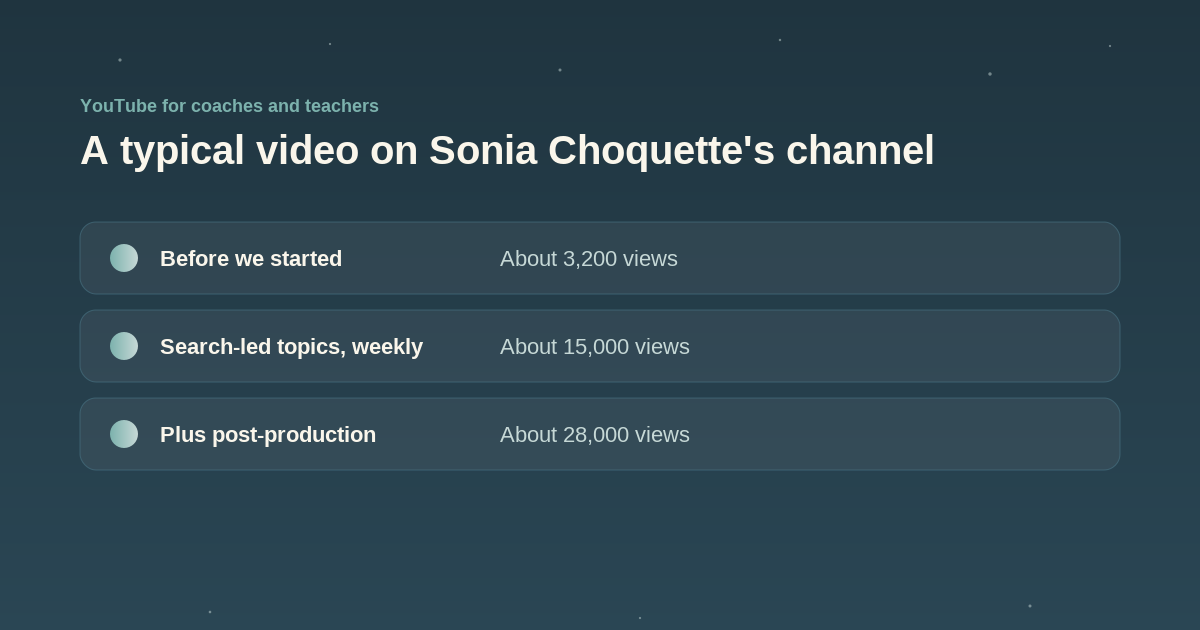
| Period | Videos | Typical video | Videos over 100,000 views |
|---|---|---|---|
| Before we started (to May 2021) | 201 | About 3,200 views | 2 |
| Search-led topics and titles (May 2021 to June 2023) | 118 | About 15,000 views | 8 |
| Plus post-production (from July 2023) | 253 | About 28,000 views | 26 |
Stage one: before
Sonia had a channel and a loyal audience, but uploads were occasional and the videos weren’t planned around what people search for. The typical video had about 3,200 views.
Stage two: plan every video around search
We took over as channel manager in May 2021. The first video under our management was “The Secret To Having GREAT Intuition,” which now has more than 77,000 views. From then on we chose topics from what her audience was already searching for, wrote titles and descriptions for search, designed thumbnails and kept a steady schedule.
The lift came quickly. The sixth video after we started, on the throat chakra, has since passed 574,000 views. Across the 118 videos of that period, the typical video had about 15,000 views, nearly five times the earlier level.
Stage three: improve sound and picture
In July 2023 we started handling post-production as well: cleaner audio, better picture and a camera setup we worked out with Sonia. The first video of that period, “Surviving The Planetary Shift,” has 537,000 views. Since then the typical video has had about 28,000 views, and about one video in ten has passed 100,000. That’s also when ad revenue became a real income source for her.
The order matters. Better production wouldn’t have helped much before the topics and titles were right. Once they were, it lifted every video.
The Soil Food Web School’s channel
The Soil Food Web School teaches regenerative agriculture, a narrower subject than intuition. We set a schedule of one long video a week, and at least three Shorts a week once Shorts arrived.
The school has since removed many older videos, so there’s no clean before and after. What remains is telling. The most-watched videos all come from our first year on the channel, and they’re the ones that answer basic questions people search for:
- “Weed Suppression Using the Soil Food Web”: 1.7 million views
- “Nutrient Cycling”: 384,000 views
- “What is the Soil Food Web?”: 246,000 views
- “Soil Carbon Sequestration and the Soil Food Web”: 242,000 views
- “Building Structure In Soil”: 125,000 views
Teaching videos that answer a common question keep collecting views for years. The school’s Shorts tell a different story: the typical Short has about 1,400 views, and none has passed 7,000. For a teaching business, long videos did the work.
A realistic timeline
- Months one to three. Research topics, set up the channel, and publish weekly. Don’t judge anything yet. A standout video can arrive early, as it did for Sonia, but don’t count on it.
- Months three to twelve. Watch which topics and titles pull views from search and suggested videos, and make more like them. This is where most channels stall, because the work feels slow.
- Year two and after. Once the topics are working, improve sound, picture and thumbnails. Each improvement now lifts every video.
Give it no less than six months: a long video every week and three Shorts every single week, for six months. Ideally, give it a whole year. Most YouTube channels don’t see those spikes in organic traffic and subscribers until they’re six months or more in.
Jason Miller, founder of Peaceful Media
What speeds it up
- Topics people already search for, phrased the way they search
- A steady schedule, ideally weekly
- Titles and thumbnails made for each video, not added at the end
- Good audio before good video, because viewers put up with a plain picture far longer than poor sound
- Long videos that teach, with Shorts as a way in rather than the main work
Getting help
We run channels for coaches, authors and schools, from topic research and titles to editing and post-production. See how we run YouTube channels, what YouTube help costs, or whether YouTube is worth it for an author or spiritual teacher.