


A certification program has a problem most courses don’t: it fills in cohorts. Each enrollment has a start date, a price in the thousands and buyers who need weeks to decide. Fill one cohort and the next starts from zero unless you’ve built something that keeps leads coming.
We ran enrollment for the Soil Food Web School, Dr. Elaine Ingham’s regenerative agriculture school, from December 2019 for four years and 17+ quarterly launches. Over that time annual revenue grew 10 times and the email list grew from under 3,000 to more than 400,000. The figures below come from our launch reports between 2019 and 2022.
Two early launches, side by side
| Foundation Courses, Dec 2019 | Launch Your Lab, Apr 2020 | |
|---|---|---|
| Price | $3,400 | $3,600, or a payment plan |
| Places sold | 100 | 252 |
| New leads | 755 | 21,745 |
| Sales | $142,800 traced to ads, on $18,250 of ad costs | About $515,000, on about $46,000 of total marketing costs |
The April 2020 launch brought in an estimated $515,000 against about $46,000 in total marketing costs: $22,800 in ads, our fee and software. What changed between the two launches is most of this article.
Start the relationship years before the launch
The thing most schools overlook happens long before enrollment opens. Jason Miller, who founded Peaceful Media, hears it from students of the high-end certifications we market:
It’s remarkable how long they feel they’ve had a relationship with the educator. Many of the people who enroll in Sonia Choquette’s launches have followed her YouTube channel for five years or more. They’ve watched all the videos, and that presence builds a huge amount of trust. It gives them faith that the promise is real and that she’ll show up and give her all. The marketing and sales happen well before you open a launch, by showing up consistently, sometimes for years, on every platform. Nothing beats direct-to-camera video for building that relationship.
Jason Miller, founder of Peaceful Media
Sonia’s channel is a good example of that groundwork. While we managed it, it grew from about 15,000 to 335,000 subscribers, and it’s where many students of her Gifted Intuitive Coach certification first got to know her. Our article on growing a YouTube channel covers the timeline.
Feed the list all year with quizzes
The biggest change was a set of scored quizzes, such as Compost IQ and Soil Biology IQ, promoted between launches. People take them because they want to know their score, and every result goes to someone who’s interested in the subject.
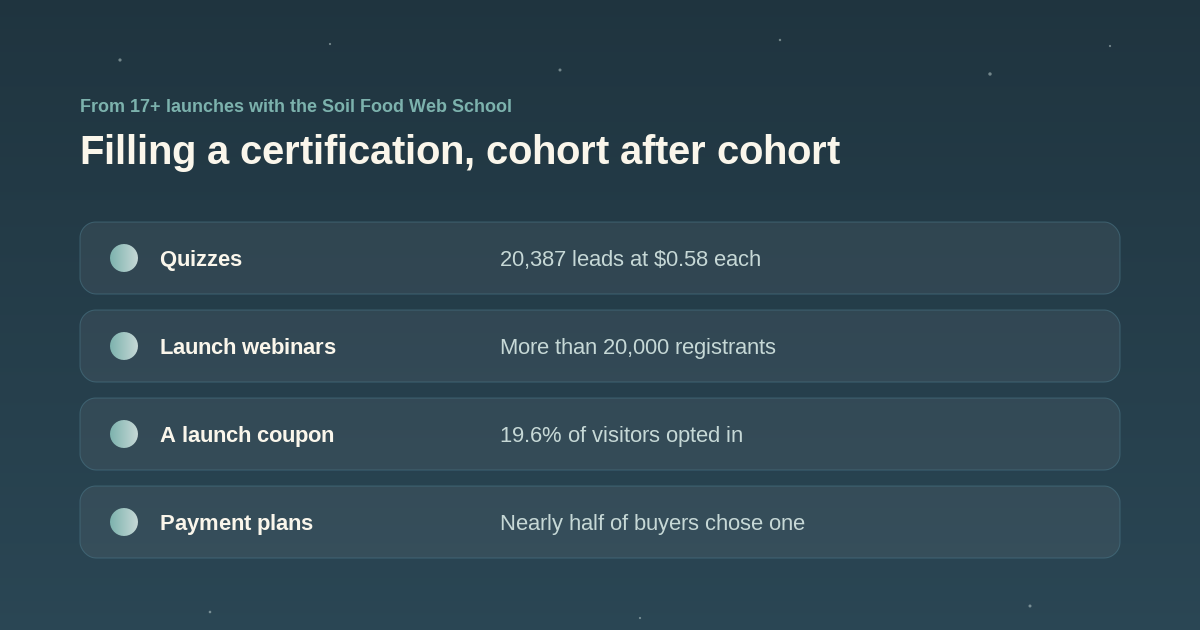
One compost quiz brought in 20,387 leads at $0.58 each. About 30% of the people who clicked through to it finished it and joined the list.
Quiz leads buy later than other leads, so judge them over months. At the close of the April 2020 launch, each quiz lead had produced $1.38 in profit after ad spend. Six weeks later the same leads had produced $5.06 each, and the quiz’s profit had grown from 1.4 times its ad spend to 7.8 times. Over their lifetime the quizzes returned about 3.7 times their ad spend.
Our guide on using a quiz to build your email list covers how to build one.
Teach before you sell, at scale
Each launch opened with free webinars that taught something useful and ended with the offer. In later launches they drew more than 20,000 registrants from email, Facebook, Google, YouTube and LinkedIn combined.
On Facebook alone, a webinar registration cost $1.78 to $3.78 across six launches, and 21% to 34% of the people who clicked the ad registered. The October 2021 launch drew 13,752 registrants from Facebook ads on their own. Our guide to what to expect from your first webinar launch covers how those numbers built up.
Give people a reason to decide now
A cohort with a start date already has a deadline, but buyers still wait until the last moment. A time-limited coupon or bonus inside the launch moves some of them sooner.
In April 2020 the coupon page converted 19.6% of visitors, against 4.5% in the 2019 launch. Coupon leads also bought at the lowest cost: across the July and October 2021 launches, a customer whose first contact was the coupon cost $313 in ads, against $593 for a launch webinar and $1,264 for a quiz.
Make the price reachable
Payment plans matter at certification prices. In the April 2020 launch, 119 of 250 buyers chose the payment plan. Later launches also offered Klarna and Afterpay on a program priced above $3,000.
Retarget the people already in the launch
Most sales came from people who had already shown interest. In April 2020, retargeting ads during the soft launch and the second week produced 61 of the 109 sales we could trace to ads, on less than $3,000 of the $22,000 ad budget.
Expect the cart-close surge
Plan your emails, ads and support for the last day. In April 2020, 89 of the 252 sales came on the final day, about a third of the launch. Across the launch, 4.4% of sales page visitors bought.
Collect leads during the launch as well as before it
Leads gathered during a launch bought at a lower cost than leads gathered before it. Across the July and October 2021 launches, a customer whose first contact came during the launch (a launch webinar or the coupon) cost $444 in ads, against $855 for one whose first contact came before it (a quiz, an educational webinar or the waitlist).
That doesn’t mean pre-launch leads are wasted. Quiz leads kept buying in later launches, and an annual online summit brought in leads at about a dollar each. Its recordings, sold as archives between launches, returned more than nine times their ad spend from November 2021 to January 2022.
Analyse every launch and change the next one
Every launch ended with a report: sales by source, cost per customer by lead type, sales page conversion day by day, and what to change. Those reports are where every figure in this article comes from, and they’re why the school’s launches kept improving. Across 17+ launches the return averaged around 700% after ad spend and our fees, and the best single month returned more than 30 times its marketing spend.
Getting help
We run launches like these for certification programs, schools and course creators. Our Focused Launch, one live event and Meta ads with every page, email and ad included, starts at $26,500 per launch, at the lower end of the $25,000 to $100,000 that Web Tonic’s October 2026 guide gives for full-service launches. Ad spend is extra. Prices are as of November 2026. See how we market certification programs, or read what launch agencies charge.