


A webinar launch teaches something useful live, then offers a program to the people who attended. It’s one of the most reliable ways to sell a course, program or certification, but the first one rarely shows what the format can do. We asked Jason Miller, who founded Peaceful Media and has run launches for schools, authors and course creators, what to expect.
Treat the first one as a prototype
Like anything else, think of it as running an experiment, building a prototype that will keep improving. Very few people knock a webinar out of the park on the first try. It’s like going to the gym. You don’t walk in bench pressing 225 pounds. You start with the 25s and work your way up.
Jason Miller, founder of Peaceful Media
Expect a modest number of attendees the first time, often mostly people already on your email list. What you’re really building is a working version of every piece: the registration page, the reminder emails, the teaching, the offer and the follow-up.
Commit to a series
Just like launching a YouTube channel, commit to doing six, ten, twelve webinars, and I can almost guarantee you’ll see a dramatic improvement. Once it’s dialed in and your marketing campaigns are set up as a proven template, everything becomes much more efficient.
Jason Miller
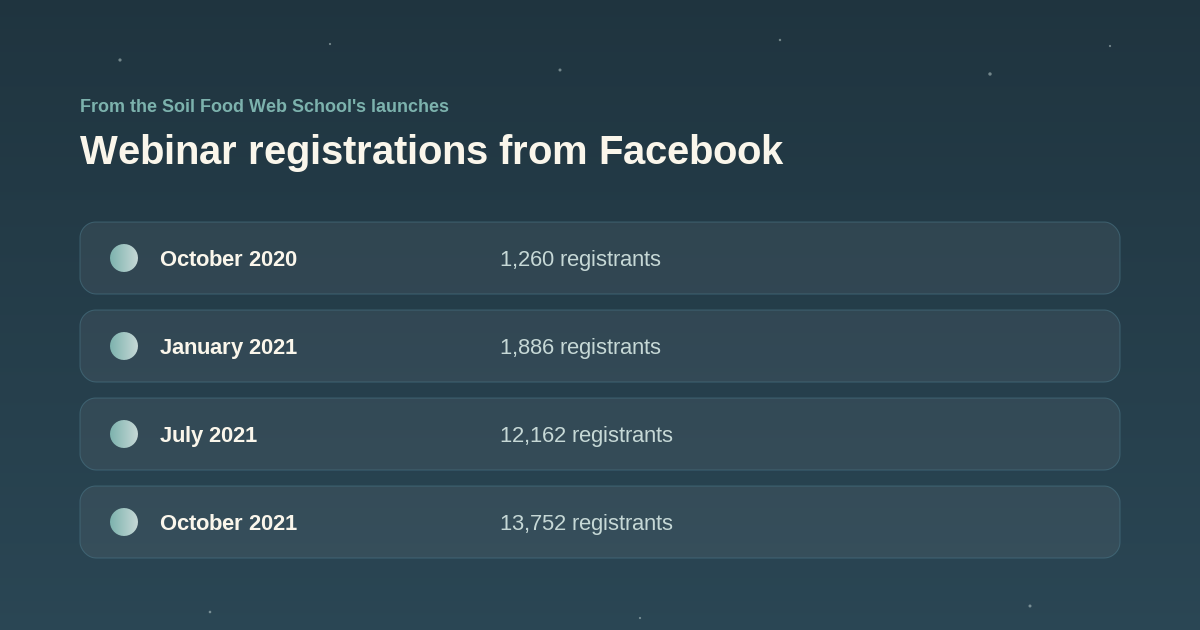
The Soil Food Web School shows what that looks like. We ran its launches from December 2019, each one opening with a series of free webinars. Registrations from Facebook ads alone grew like this:
| Launch | Facebook webinar registrants |
|---|---|
| October 2020 | 1,260 |
| January 2021 | 1,886 |
| April 2021 | 2,118 |
| July 2021 | 12,162 |
| October 2021 | 13,752 |
| January 2022 | 7,882 |
Ad spend grew alongside, from about $2,500 on webinar ads in October 2020 to about $32,000 in October 2021, as each launch proved what worked. A registration cost $1.78 to $3.78 across those launches, and 21% to 34% of the people who clicked an ad registered. Counting email, Google, YouTube and LinkedIn as well, later launches drew more than 20,000 registrants. The dip in January 2022 came as Facebook’s tracking and reach weakened, which our article on live launches and evergreen funnels covers.
Your buyers may not buy the first time
Results compound because the same people keep coming back.
Someone who attends your first webinar suddenly shows up on your fifth, seventh, ninth, and those become your buyers. At the Soil Food Web School, we’d see people go through five different launch cycles, each with a three- or four-part webinar series, before they made the investment. That’s why committing to building the muscle and continuing to show up for your audience pays off over time.
Jason Miller
So don’t judge a webinar only by the sales in the week it runs. Keep everyone who registers on your list, invite them to the next one, and track when they eventually buy.
Follow up with the people who showed interest
Most webinar sales come after the webinar itself. In the school’s April 2020 launch, retargeting ads to people who had already shown interest produced 61 of the 109 sales we could trace to ads, on less than $3,000 of a $22,000 ad budget. Plan the replay, the reminder emails and the retargeting ads as carefully as the webinar.
Every webinar is also content
Remember that all the webinar material you create also becomes short-form content and thought leadership that builds your authority on every social platform.
Jason Miller
An hour of teaching can give you a dozen short clips, several posts and an email or two, and that content brings new people to the next webinar.
A first-launch checklist
- A registration page with one clear promise and a short form
- Reminder emails the day before, the hour before and as you go live
- A teaching session that’s useful even for people who never buy
- One clear offer, with a deadline and a payment plan if the price is high
- A replay and follow-up emails for everyone who registered
- Retargeting ads for people who registered or watched
- A note of what to change next time
Getting help
We plan and run webinar launches for courses, programs and certifications. Our Focused Launch, one live event plus Meta ads with every page, email and ad included, starts at $26,500 per launch, at the lower end of the $25,000 to $100,000 that Web Tonic’s October 2026 guide gives for full-service launches. Ad spend is extra. Prices are as of November 2026. See how we run launches, how to fill a certification program every cohort, or whether to run live launches or an evergreen funnel.
Selling a program priced in the thousands? Read why a webinar and an application work best together.