


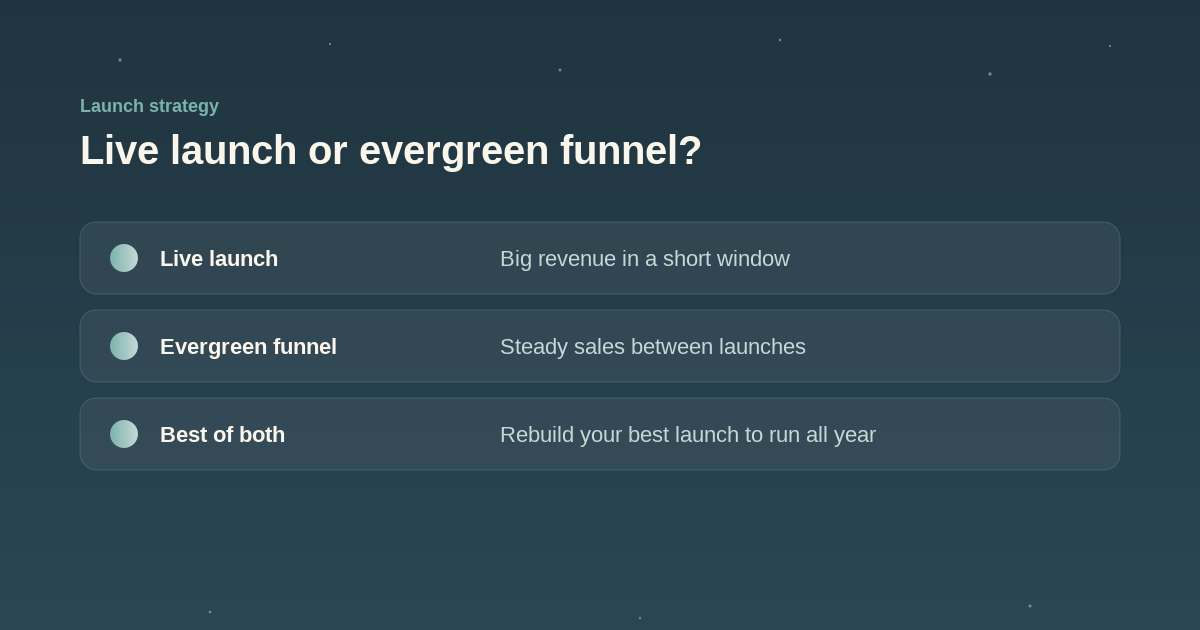
If your program costs $5,000 to $20,000, sooner or later you’ll ask whether to keep running live launches or build an evergreen funnel that sells all year. We ran 17+ quarterly launches for the Soil Food Web School, which gave us four years of data on what live launches do well and what they cost a team. The school’s figures below come from our own launch reports for it, from 2020 to 2022.
How they compare
| Live launch | Evergreen funnel | |
|---|---|---|
| Revenue | Large, in a short window | Smaller, but steady all year |
| What makes people buy | A real deadline, live teaching, a crowd buying at once | A personal deadline, recorded teaching, a sales conversation |
| Strain on the team | High, every time | High to build, then low to run |
| What you learn | A lot, in a few weeks | Slowly, as data builds up |
| Best for | New offers, big moments, testing messages | Proven offers that sell on their own merits |
What live launches do well
Live launches are hard to beat for revenue. At the Soil Food Web School, roughly 95% of revenue came from the timed launches. In April 2020, one launch sold 252 places in a $3,600 program, for an estimated $515,000, with 89 of those sales on the final day. A real deadline and a group of people deciding at once move buyers who would otherwise wait.
A live launch also teaches you fast. Every launch produced a report on what sold, which lead sources paid off and where people dropped out, and the next launch used it. Our article on filling a certification program every cohort goes through those findings.
What live launches cost you
The strain is real, even for a strong team with an agency behind it. Each launch means new emails, ads, webinars, pages and support, and on a quarterly calendar the next launch starts the week the last one ends.
Launches also get more expensive as they grow. Facebook spend per Soil Food Web School launch grew from about $12,000 in January 2021 to $90,000 in July 2021, as reach grew from about half a million people to five million. By January 2022, the cost per sale from Facebook sales ads had risen sharply. Our notes at the time put the largest share on Facebook’s weaker tracking and reach, with sales team capacity, lower consumer confidence and the end of stimulus payments also playing a part. A business that relies only on live launches feels every one of those shifts at once.
What evergreen adds
An evergreen funnel sells while your team is doing something else. Even without a full funnel, the Soil Food Web School’s always-on assets showed what’s possible between launches. From November 2021 to January 2022:
- Recordings of the school’s annual summit, sold as archives, returned more than nine times their ad spend
- Google search ads brought in 22 customers on $1,333 of spend
Prove it live before you go evergreen
Evergreen works best for an offer that already sells. Jason Miller, who founded Peaceful Media, puts it plainly:
Go evergreen once you’ve proven you can get the numbers you want in a live launch. Until then there’s no sense building an evergreen sales funnel, especially for anything priced above about $500. The most important psychological factors in a launch are urgency and scarcity, and an evergreen funnel has no real urgency and may have no scarcity. We see around half of launch sales come in the last 24 to 48 hours, when people feel the doors closing and don’t want to miss their chance. Evergreen doesn’t have that spike. So if it can’t sell live, don’t assume it will sell evergreen.
Jason Miller, founder of Peaceful Media
The Soil Food Web School’s launches showed the same pattern. In April 2020, 89 of 252 sales came on the final day alone.
Rebuild your best launch to run all year
You don’t need to choose. Once a live launch has proven the offer, take the one that sold best and rebuild it as an evergreen funnel:
- Record the teaching properly. A replay of a live webinar rarely works as well as a session filmed for people watching on their own.
- Keep the offer that sold. You already know it works.
- Replace the cart with an application and a sales call for programs above a few thousand dollars. Buyers at that price want to ask questions, and the application lets you check fit first.
- Give each person a real deadline, such as a bonus that expires a set number of days after they watch. Never fake scarcity.
- Write an email sequence that carries people from the first lesson to the application.
- Keep one or more live launches a year for new offers and big moments.
Protect the time to build it
The hardest part of evergreen is getting it made. On a quarterly launch calendar, the evergreen build is the first thing to slip, because every week goes to the next launch and filming new content keeps getting pushed back.
If you want an evergreen funnel, put it on the calendar like a launch: a date, an owner and protected time to film. Skipping one live launch to build it is often the better trade.
Getting help
We plan and run live launches and build the funnels that sell between them. See how we run launches, what they cost in our launch pricing guide, or how we market certification programs.
Selling a program priced in the thousands? Read why a webinar and an application work best together.