


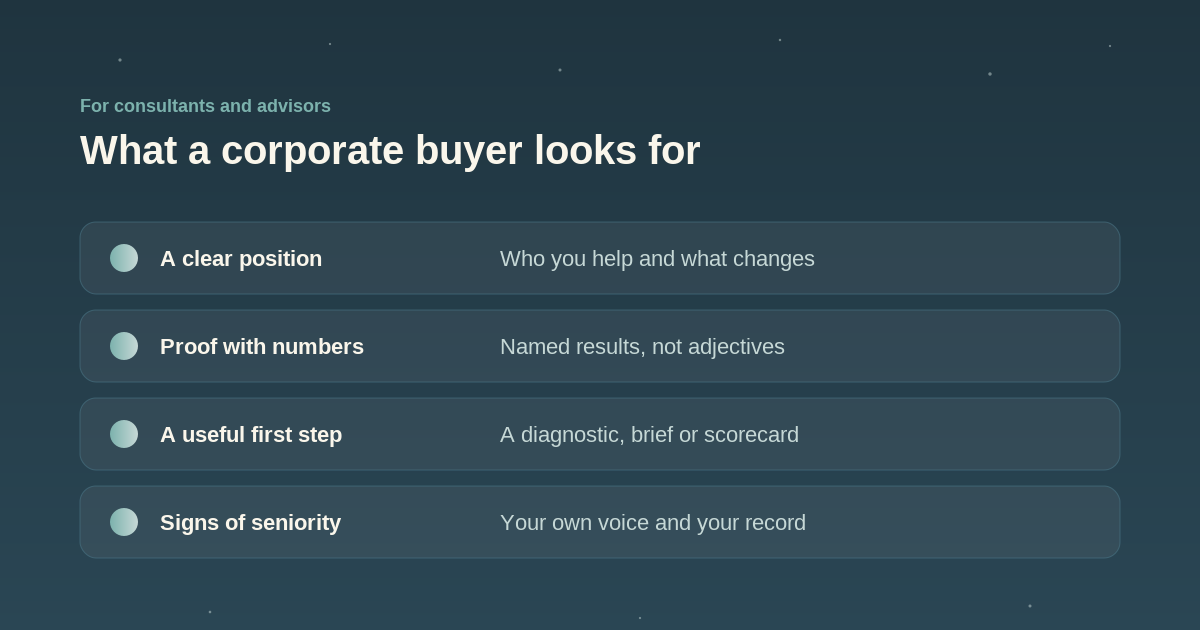
A corporate buyer who hears your name will usually check your website and LinkedIn before they agree to a call. They aren’t reading closely. They’re answering one question: is this person senior enough for us, and do they understand problems like ours?
These are the four things that answer it, and the habits that undercut them.
A clear position
The top of the page should say who you work with and what changes for them. Specific beats impressive. “I help founder-led manufacturers fix margins after they pass $10M” gives a buyer something to recognise themselves in. “Strategic consulting for growth-minded leaders” could be anyone.
For CEO advisor Michel Peruch, the position came before any design: operator, not consultant. It runs through every headline, and his About page puts it in his own words: “I fix businesses that MBAs break.” The site also says plainly who he serves, executives running $5M to $50M businesses, so the wrong buyers self-select out.
Proof with numbers
Corporate buyers are used to numbers. Tell each piece of work as a short story: the situation, what you did, and what changed, with figures wherever the client allows. Name clients where you can, and use logos only for work you actually did.
Michel’s site has a section called the Dossier, where each turnaround is told with its numbers. It does more for his credibility than any list of credentials.
Starting out with little proof
Corporate buyers are no different from anyone else: nobody wants to be the first to take a chance on you.
A corporate buyer doesn’t want to be your guinea pig. That’s why the logos and the previous work matter. If you’re just getting started as a consultant, start where you are and build up, from small and mid-sized businesses nobody has heard of to the bigger names that impress. Seeing is believing, too. If you’re new, present to local organizations and nonprofits, and get quality photos of yourself speaking to groups. Show the visitor that people already trust you with their time.
Jason Miller, founder of Peaceful Media
That gives a newer consultant three things to put on the site straight away:
- Results for the clients you do have, even if their names aren’t well known
- Photos of you presenting to real audiences
- A list of the organizations you’ve spoken to or worked with, which grows with each engagement
A useful first step
“Book a call” is a big ask for someone who found you ten minutes ago. Give them something useful first, that also tells you whether they’re a fit:
- A short diagnostic or scorecard that returns a written assessment
- A brief or checklist on a problem they recognise
- A recorded talk or case walk-through
Michel’s front door is a 15-question Business Diagnostic that takes about seven minutes. Each submission returns a written Executive Brief: a score, a plain-English diagnosis, a comparison by area and a 90-day plan of three moves. By the time someone books a call, they’ve already seen how he thinks, and he’s already read their answers.
Exit Strategy Coach works the same way for business owners thinking about selling. Its scorecard rates a business out of 60 on six value drivers and ends with the three areas costing the owner the most at sale. Michael Morrissey signed two high-end clients within seven days of it going live.
Signs of seniority
Buyers read the whole page for clues about level:
- Your own voice. Writing that sounds like you talking to a peer reads as senior. Corporate filler reads as junior.
- Your record. Former roles, companies and results, stated plainly.
- Design that matches the room. The site should look like it belongs next to the companies you advise.
Be seen taking it seriously
A buyer can’t take you seriously if they can’t see you. For Jimmy Farris, a Super Bowl champion who now coaches executives at Fortune 100 companies, part of the work was visibility: a plan of short videos posted across all his channels, built on the message we’d sharpened during the rebrand.
One response stuck with us. A viewer who went on to book Jimmy commented on one of his videos in a way that, as Jason Miller reads it, said Jimmy was now taking himself seriously.
The commenter recognized that his speaking was a real business now, not a hobby or a one-off talk for the local Rotary. Putting himself out there with content told the market he was a serious player. And the confidence his new website and materials gave him came through in the videos, because he knew that anyone who inquired wouldn’t land on a Gmail address or a broken website. Each talk had its own page and a one-sheet a buyer could share with their executive team. All of that announced that he was taking his speaking seriously, so he could command serious fees.
Jason Miller, founder of Peaceful Media
After the rebrand, Jimmy went from low four-figure speaking fees to five-figure offers from buyers who found his new content on their own.
What undercuts credibility
- Stock photos of handshakes and boardrooms
- A long list of services with no clear focus
- Claims with no numbers behind them (“proven results”, “world-class”)
- Testimonials with no name or company
- A slow site, or one that breaks on a phone
- A contact form as the only way forward
Where to start
Check your homepage against the four points above. If the first screen doesn’t say who you help and what changes, fix that first. Our free Website Analyzer checks speed, search and conversion in a few minutes.
If you’d rather have it built, our Authority Site is what we made for Michel: the positioning, pages built around proof, a lead magnet and the email follow-up, from $14,900 with copywriting included. Lyfe Marketing puts agency-built small-business websites at $5,000 to $30,000, so it sits in the lower half of that range. Prices are as of November 2026. Our website cost guide has the full breakdown.