


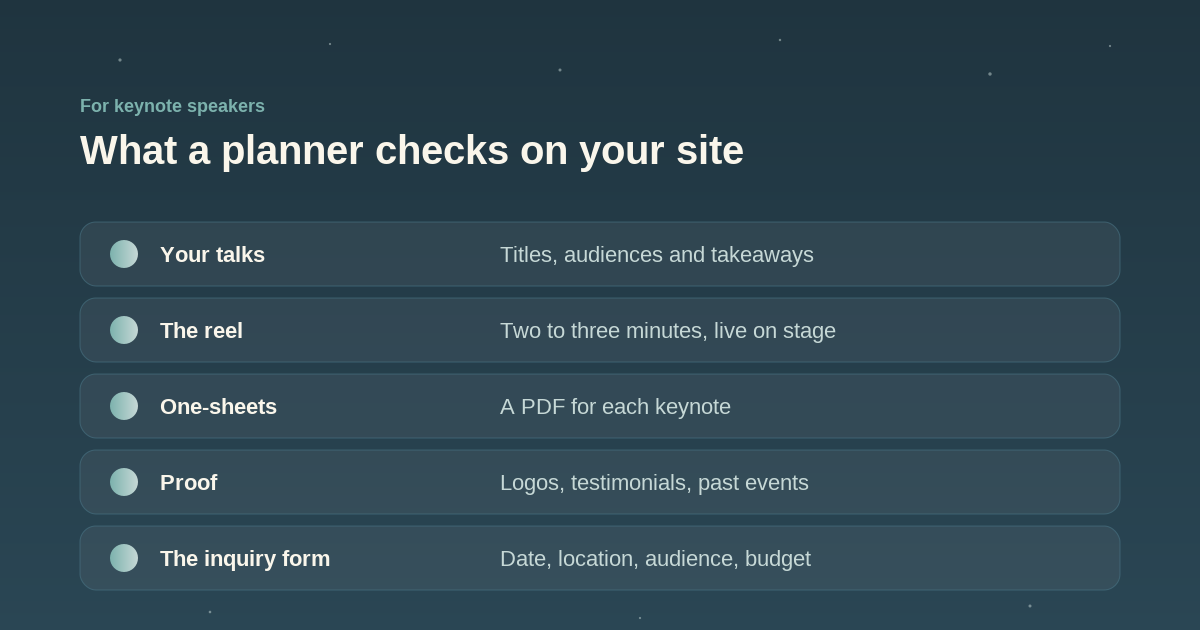
A meeting planner usually finds you through a referral, a bureau or a search, then lands on your website with one question: can I put this person forward? They’re comparing you with two or three other speakers, often on a phone, and they’ll pass your name to a committee if the page gives them what they need.
A one-page site can do that well. It needs the seven things below, in roughly the order a planner looks for them.
Who you speak to, in one line
The first screen should say who your talks are for and what changes for the audience afterwards. “Keynotes on resilience for sales teams” tells a planner more than “Inspiring audiences worldwide.” Put your name and a photo of you on stage next to it.
Your keynotes
A meeting planner needs to see that your thoughts are well articulated and that you have a menu of rock-solid, proven talks, even if none is the exact fit. Just knowing you’ve organized your ideas suggests you’ll show up prepared. Think about your pillars and build a talk around each one, and spell out what each talk is meant to fix. I wouldn’t include more than six.
Jason Miller, founder of Peaceful Media
For each talk, give the title, what it fixes, the audiences it suits and three or four takeaways. Add a line saying talks can be shaped to the organization’s needs, since planners often want a version of a talk rather than an exact match. Up to about three talks fit comfortably on one page; beyond that, give each its own page (more on that below).
A speaker reel
Planners want to see you speak before they book you. A reel of two to three minutes, filmed on a real stage with a real audience, does more than any paragraph. Show the room reacting, and include a stretch of uninterrupted speaking so they can judge your delivery.
For Jimmy Farris, the Super Bowl champion turned executive coach, we scripted and directed a reel built to show event planners and executives who he is and how he shows up on stage.
Proof
Show who has already booked you, and put it high on the page.
If a meeting planner is going to spend more than ten seconds on the page, they need to see results. We always put the logos of the stages, companies and events you’ve spoken at high up on the page, for that trust factor. Then we match endorsements and testimonials to the results of each keynote topic.
Jason Miller
So place the logos near the top, and put a testimonial next to each talk that speaks to what that talk delivered. Testimonials from planners carry more weight than audience quotes. If you’ve written a book or been quoted in the press, say so here.
A one-sheet for each keynote
A one-sheet is a one-page PDF for a single talk: title, description, audience, takeaways, a short bio, a photo and your contact details. The planner forwards it to whoever signs off, so it has to make your case without you in the room. Make each one downloadable from the page without an email gate.
Jimmy’s site has a page and a downloadable one-sheet for every keynote, so he can add a new talk without redesigning anything.
Bio and photos
Give a short bio (about 100 words) and a longer one, plus two or three high-resolution photos a planner can use in event materials. Grouped together, this works as a simple press kit.
An inquiry form that screens
“Contact me” with a name and email field wastes both sides’ time. Ask for:
- The event date and location, or whether it’s virtual
- The audience size and who’s in it
- The keynote or topic they’re interested in
- The budget range
Then reply quickly. On Jimmy’s site, inquiries trigger an automatic reply and go to the right follow-up straight away, so a planner never waits on a silent inbox.
Make it fast on a phone
Planners check speakers between meetings. The page should load quickly on a phone, the reel should play without a separate app, and the one-sheets should open without zooming. Our free Website Analyzer checks speed, search and conversion in a few minutes.
When one page isn’t enough
A single page suits a speaker with up to about three keynotes whose main business is speaking. Move to a fuller site when:
- You offer more than three keynotes and planners need to share a specific one
- You also sell coaching, workshops or advisory work
- You want to be found in Google and AI answers for your topics, which takes pages written around the questions buyers ask
- You want to grow an email list from every talk
Jimmy needed all four. His site has keynote pages, opt-ins and an 18-month email sequence that keeps his stories in front of past audiences. After the rebrand he went from low four-figure speaking fees to five-figure offers, from buyers who found his new content on their own. Our guide on turning stage authority into online visibility covers the bigger picture.
What it costs
Lyfe Marketing puts agency-built small-business websites at $5,000 to $30,000. Ours sit from just under that range to its lower half:
| Package | Price | What it is |
|---|---|---|
| Calling Card | From $4,750 | A one-page storytelling site in your existing brand, with a contact form |
| Booking Site | From $10,500 | Adds service pages, a booking page, analytics and three months of care |
| Authority Site | From $14,900 | Adds a lead magnet with its sign-up page and welcome emails, built to turn visitors into booked calls |
Copywriting is included in all three. Prices are as of November 2026. See website design for coaches, consultants and speakers for the work behind them, or read our website cost guide for the full market picture.